
Many English learners ask this question: time flies or time flys—which one is correct? These two phrases look almost the same, but only one of them is correct in English.
The correct phrase is: time flies
The phrase time flys is incorrect and should not be used.
In this lesson, I will explain everything in a very simple way so you can understand clearly and never make this mistake again.
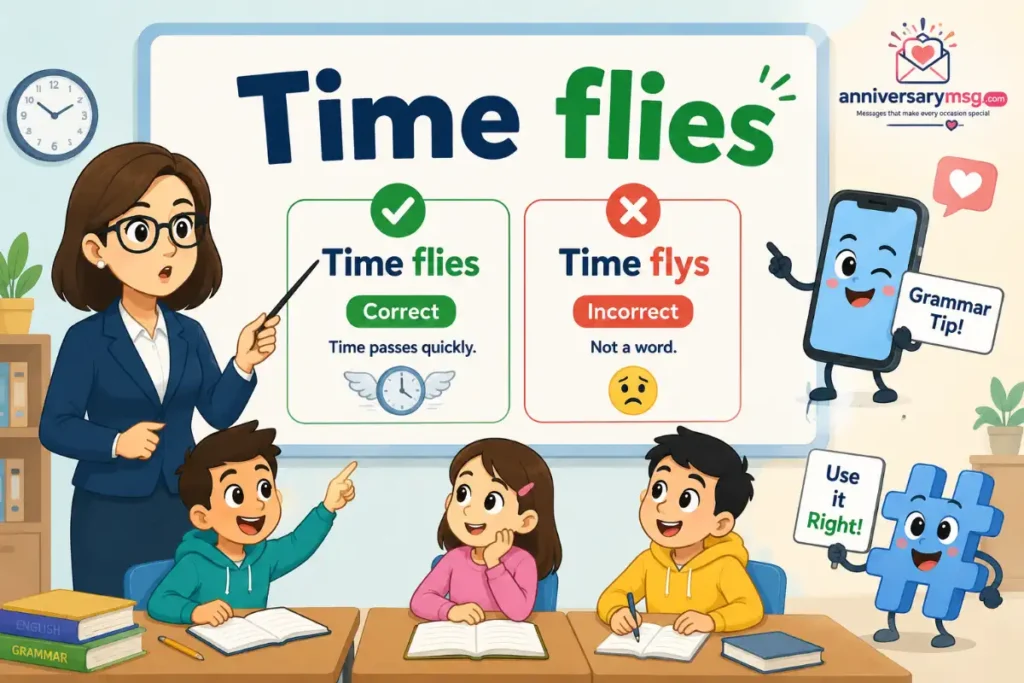
Simple Answer in One Look About Time Flies or Time Flys
- ✅ Time flies → correct
- ❌ Time flys → incorrect
What Does “Time Flies” Mean?
The phrase time flies means:
👉 Time passes very fast
Example:
Time flies when you are having fun.
This means that when you enjoy something, time feels very fast.
Why Is “Time Flies” Correct?
Let us break it into simple parts.
- Time → subject (a thing)
- Flies → verb (action word)
In English grammar, when we use:
- He / She / It (singular subject)
We add -s or -es to the verb.
Example:
He runs
She eats
It flies
So:
Time = singular → we use flies
Why “Time Flys” Is Wrong
The word flys is not the correct spelling of the verb “fly.”
The correct verb form is:
- fly → base form
- flies → correct form with “-s”
So “flys” is a spelling mistake.
Understanding the Spelling Rule About Time Flies or Time Flys
Here is a very important rule.
When a verb ends with -y, we often:
👉 Change y → ies
Example:
- fly → flies
- try → tries
- cry → cries
So:
fly → flies (correct)
flys → wrong
More Examples Like This
Let us look at similar words to make it easier.
He tries (not trys)
She cries (not crys)
It flies (not flys)
This helps you remember the rule.
Easy Sentences with “Time Flies”
Time flies when we play games.
Time flies during holidays.
Time flies when I watch movies.
Time flies when we are happy.
Time flies when you enjoy life.
All these sentences are correct.
Master me either vs me neither with easy rules, examples, and common mistakes to avoid.
Common Expression
The most common sentence is:
Time flies when you are having fun.
This is a very popular English expression.
Time Flies: Full Comparison of Time Flies or Time Flys
Let us compare both forms in a simple way.
Meaning
- Time flies → time passes quickly
- Time flys → no meaning (incorrect form)
Grammar
- Time flies → correct grammar
- Time flys → wrong spelling
Usage
- Time flies → used in speaking and writing
- Time flys → should not be used
Spelling Rule
- fly → flies (correct)
- fly → flys (wrong)
Quick Comparison
- Correct → time flies
- Incorrect → time flys
- Reason → spelling + grammar rule
Real-Life Examples of Time Flies or Time Flys
Here are simple examples about Time Flies or Time Flys you can use in daily life:
Time flies when I am with my friends.
Time flies during vacations.
Time flies at school.
Time flies when we laugh.
Time flies when we are busy.
Common Mistakes to Avoid
Mistake 1: Writing “flys”
Wrong:
Time flys very fast.
Correct:
Time flies very fast.
Mistake 2: Forgetting the “-ies” rule
Always remember:
- y → ies
Mistake 3: Not checking spelling
Small spelling mistakes can change meaning or make sentences incorrect.
Teacher Tip (Very Important)
If you see a verb ending in y, check the subject.
If the subject is singular (he, she, it, time), change:
- y → ies
This will help you avoid many mistakes.
Practice Exercise
Fill in the blank:
- Time __ when you are happy.
- Time __ during holidays.
- Time __ when we play.
Correct answer: flies
Why Do People Write “Time Flys” by Mistake?
Many learners write time flys because they follow the wrong spelling pattern. They think adding -s is enough for all verbs. But English has special rules for verbs that end in -y.
Another reason is pronunciation. When we say “flies,” it sounds soft, and some learners think it is spelled “flys.” This confusion is very common, especially for beginners.
Also, many people type quickly and do not check spelling. This leads to mistakes like “flys.” That is why learning the rule clearly is very important.
Understanding the “Y to IES” Rule in Detail
This rule is very important in English grammar.
When a verb ends with a consonant + y, we change:
👉 y → ies
Examples:
- fly → flies
- try → tries
- cry → cries
- carry → carries
So we do not say:
❌ flys
❌ trys
❌ crys
We always use:
✅ flies
✅ tries
✅ cries
This rule helps you write correct English every time.
Difference Between “Fly” as a Verb and “Fly” as a Noun
The word fly can be used in two ways.
As a Verb (Action)
It means to move in the air.
Example:
Birds fly in the sky.
When used with “time,” it becomes:
Time flies.
As a Noun (Thing)
It can mean a small insect.
Example:
There is a fly in the room.
So remember:
- Fly (verb) → action
- Fly (noun) → insect
But “time flies” always uses the verb form.
Similar Sentences You Should Learn
Learning similar sentences helps you remember better.
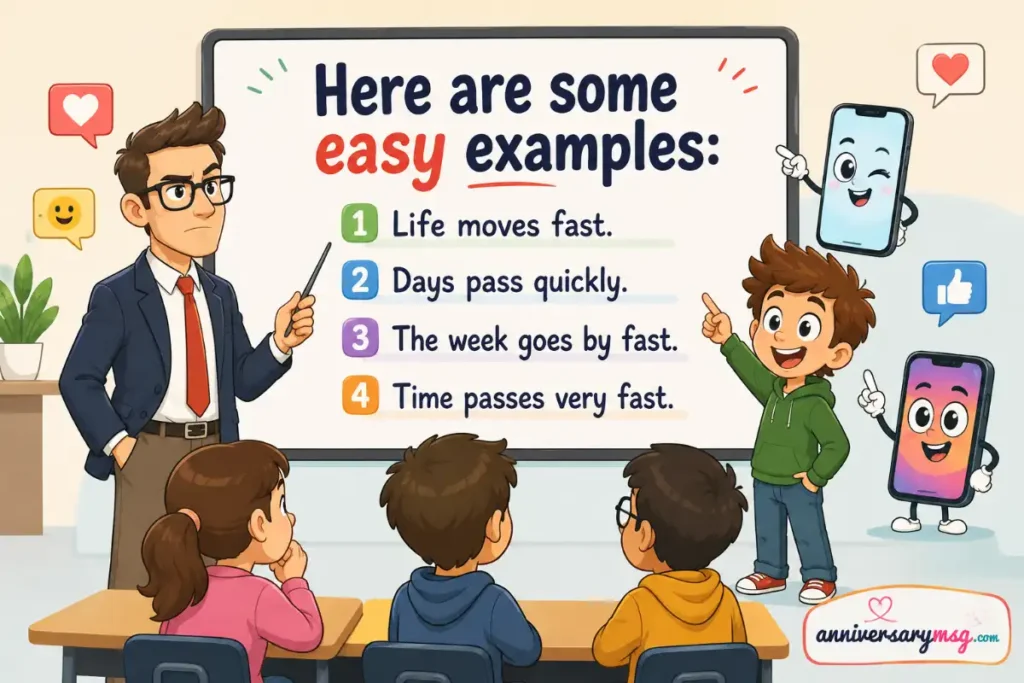
Here are some easy examples:
Life moves fast.
Days pass quickly.
The week goes by fast.
Time passes very fast.
Hours go quickly when we are busy.
All these sentences have the same idea as time flies.
When Do We Use “Time Flies” in Real Life?
We use time flies when we feel that time is going very fast.
Common situations:
- When having fun
- During holidays
- While talking with friends
- When working on something interesting
- When enjoying life
Examples:
Time flies when I play games.
Time flies during vacations.
Time flies when I am with my family.
Time flies when I watch my favorite show.
This phrase is very common in daily conversation.
Final Answer About Time Flies or Time Flys
The correct phrase is time flies.
- It follows grammar rules
- It follows correct spelling
- It is used in everyday English
“Time flys” is incorrect and should not be used.
Conclusion
Now you clearly understand the difference between time flies or time flys. This is a simple but very common mistake in English. The correct form is “time flies” because it follows both grammar and spelling rules. The word “flies” comes from the verb “fly,” where the “y” changes to “ies” when used with a singular subject like “time.”
The best way to remember this is to practice similar words like “tries,” “cries,” and “flies.” When you see a verb ending in “y,” always think about the rule. With regular practice, you will stop making this mistake and start using the correct form naturally in both writing and speaking.
Frequently Asked Questions (FAQs)
Is time flies correct?
Yes, it is correct.
Is time flys correct?
No, it is incorrect.
Why do we use flies?
Because of the “y to ies” spelling rule.
What does time flies mean?
It means time passes quickly.
Is this a common mistake?
Yes, many learners make this mistake.

Ryan is a creative writer and relationship content specialist who believes in the power of meaningful words. He focuses on anniversaries, love notes, and memorable messages that make people feel connected. When not writing, Ryan loves kayaking, attending live jazz performances, and collecting vintage postcards from his travels.