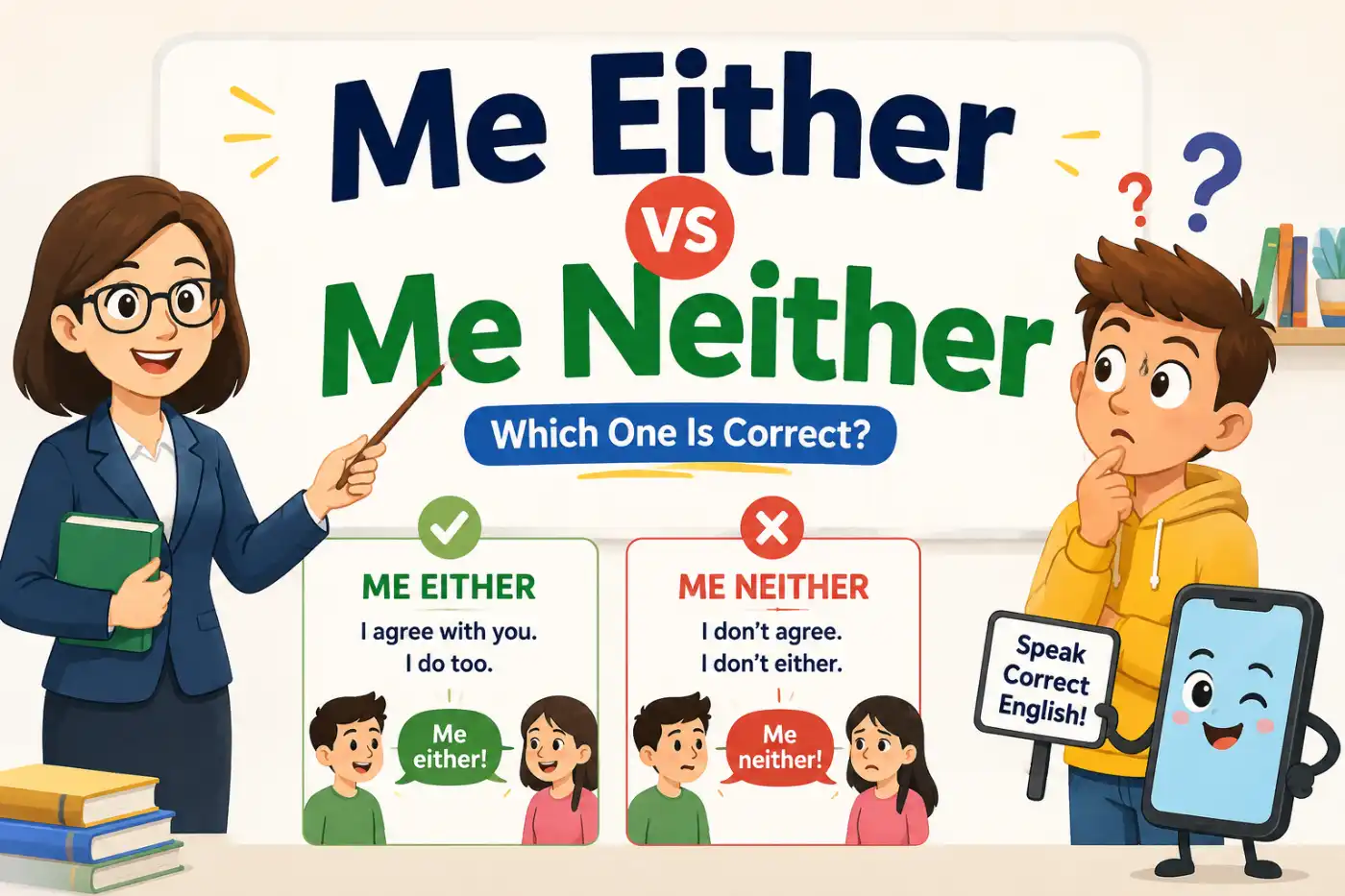
If you have ever wondered about me either vs me neither, you are not alone. Many English learners hear both expressions in everyday conversations and wonder which one is correct. The good news is that the basic rule is simple.
Use me neither when you agree with a negative statement. Use me either when you use the word “either” to agree with a negative statement in a sentence. Both can be heard in casual American English, but they do not work in exactly the same way.
For example, if someone says, “I don’t like cold coffee,” you can say, “Me neither.” You can also say, “I don’t like it either.” These two replies have the same basic meaning: you also don’t like cold coffee.
Simple Answer in One Look About Me Either vs Me Neither
The easiest rule about Me Either vs Me Neither is this:
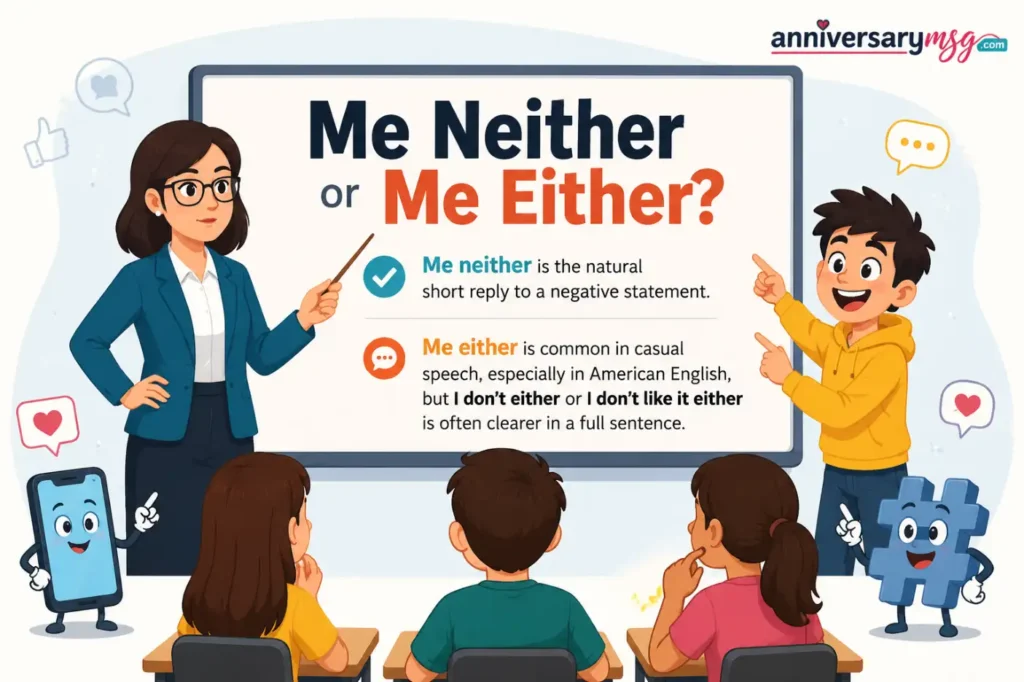
Me neither is the natural short reply to a negative statement.
Me either is common in casual speech, especially in American English, but I don’t either or I don’t like it either is often clearer in a full sentence.
Here is a quick example.
“I don’t watch baseball.”
“Me neither.”
“I don’t watch baseball either.”
Both replies show that you also do not watch baseball.
So, if someone asks, “Which is correct, me either or me neither?” the safest simple answer is me neither for a short reply.
Compare the correct forms in our detailed dreamed or dreamt guide.
What Me Either vs Me Neither Means in Simple English
Think of these expressions as ways to say, “I agree with you.”
The only question is what you are agreeing with.
If a person says something positive, you normally use me too.
“I love pizza.”
“Me too.”
The second person means, “I love pizza too.”
Now look at a negative statement.
“I don’t like mushrooms.”
“Me neither.”
The second person means, “I don’t like mushrooms either.”
This is the basic idea behind me either vs me neither.
The word neither carries a negative idea. It means “not this one and not that one” or, in this type of reply, “not me either.”
The word either can also appear with a negative sentence.
“I don’t like mushrooms either.”
Here, “either” comes after the negative part of the sentence.
That small difference helps you choose the right expression.
A simple way to remember it is:
Positive statement → Me too.
Negative statement → Me neither.
Negative full sentence → I don’t either.
This pattern works in many everyday conversations.
“I can’t swim.”
“Me neither.”
“I don’t have a car.”
“Me neither.”
“I haven’t seen that movie.”
“Me neither.”
“I don’t eat spicy food.”
“Me neither.”
The expression is short, natural, and common in spoken English.
Why People Mix Me Either vs Me Neither
People often confuse these expressions because either and neither can both be connected to negative ideas.
That can make English feel tricky.
Imagine two friends talking.
“I don’t like rainy days.”
“Me neither.”
The meaning is easy. The second friend agrees with the negative statement.
But you may also hear:
“I don’t like rainy days either.”
This sounds different because the second person gives a complete sentence.
Now imagine a learner hears someone say:
“I don’t like rainy days either.”
The learner may think, “Why can’t I just say me either?”
This is where the confusion starts.
In casual American speech, you may hear people say “me either.” It can sound natural in relaxed conversation. However, many teachers prefer me neither as the short reply to a negative statement.
There is another reason for the confusion. English speakers use either in many different ways.
For example:
“You can choose either door.”
“I don’t want either one.”
“I don’t like coffee either.”
These uses are related, but they follow different patterns.
The word neither also has several uses.
“Neither answer is correct.”
“Neither of them came.”
“Me neither.”
Because of this, learners may see both words often and assume they can always replace one with the other.
They cannot.
The safest approach is to learn the common sentence patterns instead of trying to translate each word directly from another language.
Clear Difference Explained Simply
Here is the easiest comparison.
| Expression | Basic use | Example |
|---|---|---|
| Me too | Agree with a positive statement | “I like cats.” “Me too.” |
| Me neither | Agree with a negative statement | “I don’t like cats.” “Me neither.” |
| I don’t either | Agree with a negative statement in a full sentence | “I don’t like cats either.” |
| Me either | Heard in casual speech, especially in some American conversations | “I don’t like cats.” “Me either.” |
The key difference is the role of either and neither.
Neither already has a negative meaning.
Either can be used in a negative sentence, but the negative word usually appears somewhere else.
For example:
“I don’t want it either.”
The word “don’t” makes the sentence negative.
Now compare:
“Me neither.”
The word “neither” gives the short reply its negative meaning.
This is why “me neither” is such a useful pattern.
You do not need to say:
“I don’t like it.”
You can simply say:
“Me neither.”
The listener understands that you also don’t like it.
A Simple Memory Trick
Think of too with positive ideas and neither with negative ideas.
“I am tired.”
“Me too.”
“I am not tired.”
“Me neither.”
“I like chocolate.”
“Me too.”
“I don’t like chocolate.”
“Me neither.”
This simple pattern will help you in most everyday situations.
Me Either vs Me Neither: Which Form Should You Use?
If you want the safest choice in everyday American English, use me neither after a negative statement.
For example:
“I don’t like scary movies.”
“Me neither.”
“I haven’t been to Texas.”
“Me neither.”
“I can’t drive.”
“Me neither.”
“I don’t understand this question.”
“Me neither.”
This sounds natural and clear.
You can also use a complete sentence with either.
“I don’t like scary movies either.”
“I haven’t been to Texas either.”
Or “I can’t drive either.”
“I don’t understand this question either.”
These sentences are also correct.
The expression me either is more complicated because its use varies by speaker and situation. Some native speakers use it in casual conversation. You may hear it in relaxed American speech.
However, if you are learning English and want a simple rule for school, work, or careful writing, me neither is the better short answer.
You can also avoid the question completely by using a full sentence.
Instead of saying:
“Me either.”
Say:
“I don’t either.”
Or say:
“I don’t like it either.”
This makes your meaning very clear.
So the practical rule is:
Negative statement + short agreement → Me neither.
Negative statement + full sentence → I don’t either or I don’t … either.
Easy Real-Life Sentences You Can Use
Here are some simple examples you can use in daily conversation.
“I don’t like coffee.”
“Me neither.”
“I don’t have a pet.”
“Me neither.”
“I can’t cook very well.”
“Me neither.”
“I haven’t watched that show.”
“Me neither.”
“I don’t understand this math problem.”
“Me neither.”
“I don’t want to go outside today.”
“Me neither.”
“I haven’t visited New York.”
“Me neither.”
You can also use either in full sentences.
“I don’t like coffee either.”
“I don’t have a pet either.”
Or “I can’t cook very well either.”
“I haven’t watched that show either.”
“I don’t understand this math problem either.”
Or “I don’t want to go outside today either.”
“I haven’t visited New York either.”
Notice the pattern.
The word either usually comes near the end of a negative sentence.
That is one of the easiest ways to recognize its common use.
Where This Expression Comes From Simple History
The words either and neither have a long history in English.
Both words are connected to older forms of English and have changed in pronunciation and use over time.
In modern English, either can mean one of two choices or can appear at the end of a negative sentence.
For example:
“You can take either road.”
“I don’t like either option.”
“I don’t like it either.”
Neither usually connects two negative choices or ideas.
For example:
“Neither answer is right.”
“Neither student knew the answer.”
It also appears in the short reply:
“Me neither.”
The phrase became a common part of spoken English because people naturally shorten replies during conversations.
Instead of repeating the whole sentence, a speaker can simply say:
“Me neither.”
The listener already knows what the speaker means.
That makes the expression useful in quick everyday conversations.
Moving From the Basic Rule to Real English
Now that the main rule is clear, we can look at how these expressions work in real conversations.
English is not only about memorizing rules. It is also about understanding how people actually speak.
You may hear different forms in movies, classrooms, family conversations, social media, and everyday American speech.
The important thing is to understand the meaning first and then choose the form that fits your situation.
How Me Either vs Me Neither Is Understood in Culture and Stories
In American English, short replies are very common.
People often do not repeat the whole sentence when the meaning is already clear.
For example:
“I love ice cream.”
“Me too.”
There is no need to say, “I love ice cream too.”
The shorter answer feels natural.
The same thing happens with negative statements.
“I don’t like winter.”
“Me neither.”
The speaker saves words because both people understand the subject.
This style is common in friendly conversations.
You might hear it at school, at home, at work, or while talking with friends.
Short replies can also make a conversation sound more relaxed.
Imagine this conversation:
“I don’t want to wake up early tomorrow.”
“Me neither.”
“I’m going to sleep early tonight.”
“Me too.”
The speakers are not trying to give a grammar lesson. They are simply agreeing with each other.
This is why learning the meaning and pattern is more useful than memorizing a complicated rule.
In stories and movies, you may also see these expressions used to show that two characters have the same feelings.
One character says:
“I don’t trust him.”
The other says:
“Me neither.”
That tiny reply tells us that both characters share the same opinion.
Biblical and Mythological Meaning If Applicable
There is no special biblical or mythological meaning attached to the phrase me neither.
The expression is an everyday English construction. It does not represent a religious belief, myth, or ancient symbol.
You may find words such as neither and either in older translations of religious texts because these are ordinary English words.
For example, neither can be used to describe two things that are both excluded.
But that does not give the modern conversational phrase “me neither” a special religious meaning.
The same applies to mythology.
Ancient stories may use ideas such as “neither person” or “either choice,” but the modern conversational expression is simply a way to agree with a negative statement.
So there is no hidden cultural or religious meaning that English learners need to memorize.
Symbolism Explained in Simple Words
These expressions do not have a fixed symbolic meaning.
Still, we can understand the simple idea they communicate.
What One Version Represents
Me neither represents agreement with a negative idea.
If someone says:
“I don’t like loud music.”
And you say:
“Me neither.”
You are saying that you share the same negative feeling.
The phrase creates a small connection between two speakers.
It says:
“You feel this way, and I feel this way too.”
The word neither helps show that the shared idea is negative.
What the Other Version Represents
Me either can represent the same general idea in casual speech.
However, it is less useful as a simple rule for English learners because standard sentence patterns normally use either with another negative word.
For example:
“I don’t like loud music either.”
This is clear and natural.
You can think of either as joining an additional negative idea to an existing negative sentence.
The first speaker says:
“I don’t like loud music.”
The second speaker says:
“I don’t like it either.”
The second person adds their own negative agreement.
That is why the complete sentence with either is easy to understand.
Related Words You Should Know
There are several expressions that can help you understand this topic.
Me too
Use me too to agree with a positive statement.
“I love summer.”
“Me too.”
It means, “I love summer too.”
Me neither
Use me neither to agree with a negative statement.
“I don’t like summer.”
“Me neither.”
It means, “I don’t like summer either.”
Either
Either can mean one of two choices.
“You can choose either shirt.”
It can also appear in a negative sentence.
“I don’t like either shirt.”
It can also appear at the end of a negative sentence.
“I don’t like this shirt either.”
Neither
The Neither often means not one and not the other.
“Neither answer is correct.”
It can also be used in a short reply.
“I don’t know the answer.”
“Me neither.”
I don’t either
This is a full way to agree with a negative statement.
“I don’t watch football.”
“I don’t either.”
It is clear and easy to understand.
I haven’t either
Use this pattern when the first speaker uses “haven’t.”
“I haven’t seen that movie.”
“I haven’t either.”
This keeps the verb pattern clear.
I can’t either
Use this when the first person says they cannot do something.
“I can’t swim.”
“I can’t either.”
This is another natural way to agree with a negative statement.
How People Actually Use It in Daily English
The best way to learn the difference is to see it in normal conversations.
Talking About Food
“I don’t eat seafood.”
“Me neither.”
The second person means they also don’t eat seafood.
Talking About Movies
“I haven’t seen that movie.”
“Me neither.”
Both people have not seen it.
Talking About Travel
“I’ve never been to Alaska.”
“Me neither.”
Both speakers have never visited Alaska.
Talking About Skills
“I can’t play the piano.”
“Me neither.”
Both people cannot play the piano.
A full reply would be:
“I can’t play the piano either.”
Talking About School
“I don’t understand this question.”
“Me neither.”
The short reply shows shared confusion.
Talking About Work
“I don’t like working late.”
“Me neither.”
Both people dislike working late.
Talking About Weather
“I don’t like very cold weather.”
“Me neither.”
The second person agrees.
Talking About Plans
“I don’t want to go out tonight.”
“Me neither.”
Both people want to stay home.
Talking About Hobbies
“I don’t play video games.”
“Me neither.”
The speakers share the same habit.
Talking About Experiences
“I’ve never ridden a horse.”
“Me neither.”
Both people have not had that experience.
These examples show why me neither is so useful. It lets you agree without repeating the entire sentence.
Common Mistakes People Make in Me Either vs Me Neither
One common mistake is using me too after a negative sentence.
For example:
“I don’t like onions.”
“Me too.”
This can sound confusing because “me too” normally agrees with a positive idea.
A clearer reply is:
“Me neither.”
Another mistake is thinking that me either and me neither are always interchangeable.
They are not the best choices in every sentence.
For example:
“I don’t like this movie either.”
This is a complete negative sentence.
You would not normally replace “either” with “neither” in that exact sentence.
You could say:
“I don’t like this movie either.”
Or:
“Me neither.”
But these are two different sentence patterns.
Another mistake is using neither after a positive statement.
“I love pizza.”
“Me neither.”
That does not make sense because the first statement is positive.
The natural reply is:
“Me too.”
Another common mistake is forgetting the negative word when using either.
“I like it either.”
This does not work for the meaning we want.
Say:
“I don’t like it either.”
The word “don’t” gives the sentence its negative meaning.
Another mistake happens when learners try to translate directly from their first language.
English often uses short patterns that do not match word-for-word translations.
Instead of translating each word, learn the complete pattern.
Positive:
“I like it.”
“Me too.”
Negative:
“I don’t like it.”
“Me neither.”
Full negative agreement:
“I don’t like it either.”
This approach is much easier.
Final Teacher Explanation of Me Either vs Me Neither Very Important
If I were explaining this to a fifth-grade English class, I would put three sentences on the board about me either vs me neither.
“I like apples.”
“I don’t like apples.”
And “I don’t like apples either.”
Then I would ask the class how someone could agree with each sentence.
For the first sentence:
“Me too.”
For the second sentence:
“Me neither.”
For the third sentence, the sentence already includes either.
The big idea is simple.
Too normally follows a positive idea when you are agreeing.
Neither works well as a short reply to a negative idea.
Either often appears at the end of a negative sentence.
You do not need to memorize ten difficult grammar rules.
Just remember these examples:
“I am happy.”
“Me too.”
“I am not happy.”
“Me neither.”
“I don’t like it.”
“Me neither.”
“I don’t like it either.”
“I don’t either.”
That is enough to handle most everyday situations.
Now what about me either?
You may hear it in casual American conversation. Some native speakers use it naturally.
That does not mean you need to make it your first choice.
If you are writing for school, taking an English test, or trying to use a safe standard pattern, choose me neither as the short reply to a negative statement.
If you want to use either, make a full negative sentence.
For example:
“I don’t like it either.”
This gives you a clear and useful rule.
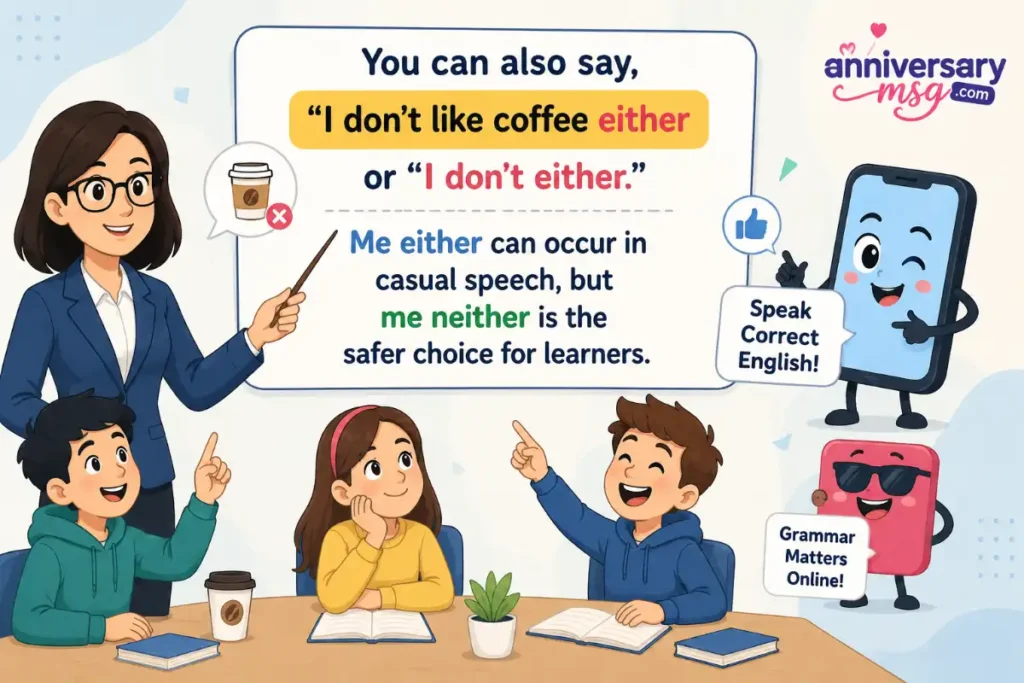
Final Answer Quick Recap About Me Either vs Me Neither
The easiest answer to me either vs me neither is me neither when you are giving a short reply to a negative statement.
“I don’t like coffee.”
“Me neither.”
You can also say, “I don’t like coffee either” or “I don’t either.” Me either can occur in casual speech, but me neither is the safer choice for learners.
Conclusion
The difference between me either vs me neither is easier than it first seems. When someone makes a negative statement and you want to agree, me neither is the safest short reply. You can also use I don’t either or place either at the end of a full negative sentence, such as “I don’t like coffee either.” While you may hear me either in casual American speech, it isn’t the best choice for learners who want a clear and standard pattern.
The easiest way to remember the rule is to connect me too with positive statements and me neither with negative statements. Once you learn these simple patterns, you’ll be able to use them naturally in conversations, school writing, and everyday American English. When in doubt, choose me neither for a short negative reply and either when building a full negative sentence.
Frequently Asked Questions FAQs
Is me neither correct English?
Yes. Me neither is a natural short reply when you agree with a negative statement.
Is me either correct English?
You may hear me either in casual American speech. For standard and clear English, use me neither as a short negative reply.
What is the difference between me either and me neither?
Me neither is used as a short reply to a negative statement. Either normally appears in a negative sentence such as “I don’t like it either.”
Can I say me neither after a positive sentence?
No. Use me too after a positive statement.
“I love music.”
“Me too.”
When should I use me neither?
Use it when someone makes a negative statement and you want to say that you feel or do the same thing.
“I don’t watch TV.”
“Me neither.”
Can I use either instead of neither?
Not in every situation. You can use either in a full negative sentence, such as “I don’t watch TV either.”
Is me neither formal or informal?
It is common in everyday conversation. In formal writing, a complete sentence such as “I don’t either” may be clearer.
What is the easiest way to remember the rule?
Remember this simple pattern: positive statement → me too. Negative statement → me neither. A full negative sentence can use either.

Ryan is a creative writer and relationship content specialist who believes in the power of meaningful words. He focuses on anniversaries, love notes, and memorable messages that make people feel connected. When not writing, Ryan loves kayaking, attending live jazz performances, and collecting vintage postcards from his travels.