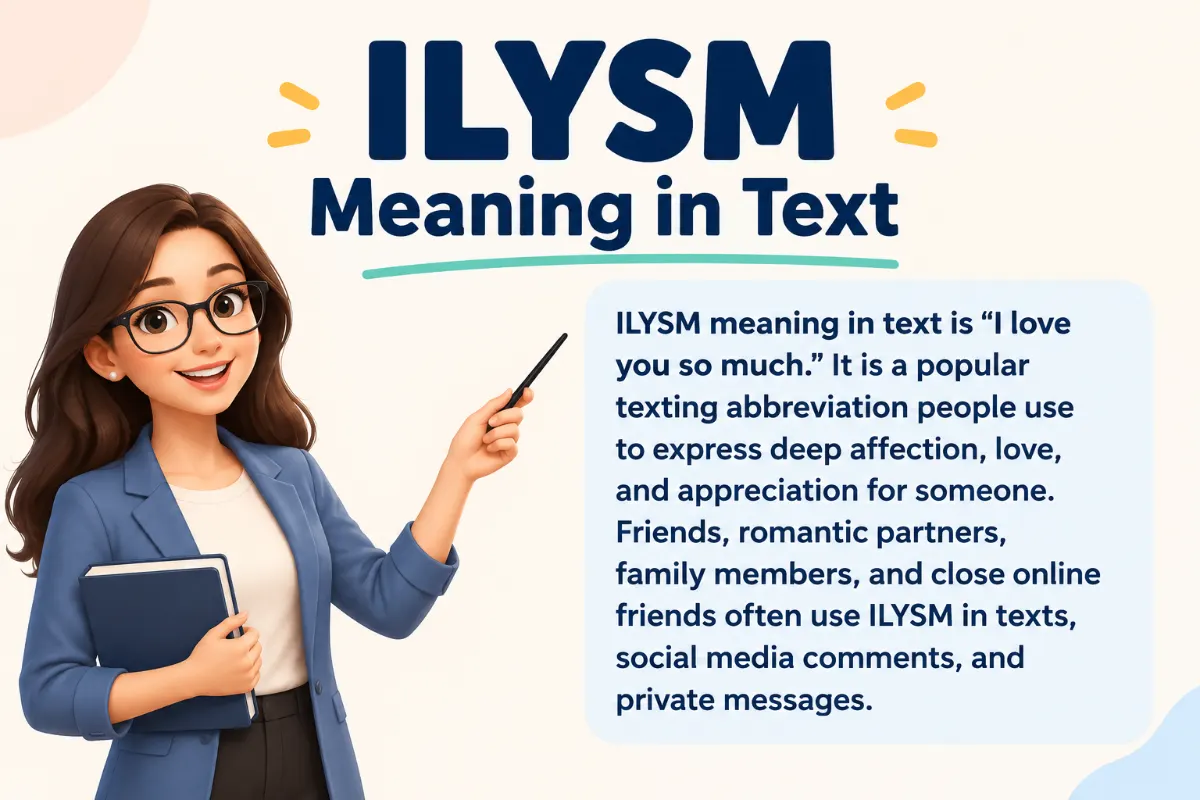
ILysm meaning in text is “I love you so much.” It is a popular texting abbreviation people use to express deep affection, love, and appreciation for someone. Friends, romantic partners, family members, and close online friends often use ILYSM in texts, social media comments, and private messages.
ILysm is a shortened version of a loving phrase that saves time while keeping a message warm and personal. People often send it when they feel grateful, miss someone, or want to make another person feel special.
You might see it in a good morning text, a sweet reply, a birthday message, or a conversation with someone you care about. The exact meaning depends on your relationship and the situation.
ILYSM at a Glance
| Category | Meaning |
|---|---|
| Part of speech | Initialism used as an expression |
| Definition | I love you so much |
| Language of origin | English |
| Context of use | Text messages, social media, friendships, and romantic relationships |
| Pronunciation | Usually pronounced letter by letter as I-L-Y-S-M |
What Does It Mean
ILysm stands for I Love You So Much. People use these five letters to express strong feelings without typing the entire phrase.
For example, someone might text, “Thank you for always being there for me. ILYSM.” This message communicates love and gratitude in a short, personal way.
The abbreviation can express different kinds of affection. A girlfriend might send it to her boyfriend, a boy might use it with someone he loves, or a friend might write it to show appreciation after receiving support.
The meaning isn’t always romantic. Your relationship with the sender, the conversation, and their usual texting style can help you understand the intended emotion.
Deeper Meaning and Significance
Beyond its literal definition, ILYSM helps people communicate warmth and emotional closeness through digital messages. Its meaning can feel playful, romantic, supportive, or deeply personal depending on who sends it and why.
Primary Meaning
The primary meaning is I love you so much. It expresses strong affection for another person and often adds emotional emphasis to an ordinary message.
Consider these examples.
- “You made my entire day. ILYSM.”
- “I can’t imagine life without you. ILYSM.”
- “Thanks for helping me through everything. ILYSM.”
Each example expresses affection, but the reason behind the feeling changes. The first sounds cheerful, the second feels romantic, and the third shows gratitude and emotional support.
Secondary Meaning
In some conversations, ILYSM carries a broader message of appreciation, trust, and belonging. Someone might use it to celebrate a close friendship, thank a family member, or react to a thoughtful gesture.
It can also have a funny or playful meaning. For instance, a friend might text, “You brought me fries? ILYSM 😂.” The message expresses genuine appreciation while adding humor to the conversation.
However, the abbreviation doesn’t automatically prove romantic interest. Look at the person’s behavior and the wider conversation before drawing conclusions about their feelings.
Origin and Etymology
Historical Background
ILysm developed as part of the wider growth of internet slang and digital communication. As people began using chat rooms, instant messaging, and mobile text messages, they adopted shorter expressions to communicate quickly.
The phrase “I love you so much” was already common in everyday English. The abbreviation simply condensed it into a form that was easy to type and recognize.
Language Roots
The abbreviation comes from the first letters of its English words.
- I stands for I.
- L stands for love.
- Y stands for you.
- S stands for so.
- M stands for much.
Together, these letters form ILYSM. It belongs to the same family of internet abbreviations as ILY, which means “I love you,” and ILU, another shortened form of the same expression.
Evolution of the Term
The abbreviation became familiar through texting, online chats, social networking sites, and messaging apps. Its use spread as people looked for quick ways to express affection in digital conversations.
Today, you can find it in private messages, comments, captions, and everyday online exchanges. People may write it as ILYSM, ilysm, or Ilysm. The capitalization changes, but the meaning stays the same.
Examples in Sentences
These examples show how people naturally use the abbreviation in everyday conversations. The tone can change depending on the relationship and the message around it.
Real Life Examples
- “You always know how to make me smile. ILYSM.”
- “Happy birthday to my favorite person. ILYSM and hope your day is amazing.”
- “Thank you for listening when I needed someone. ILYSM.”
Everyday Usage
People usually use this abbreviation when they want to express affection quickly without making a message feel formal. It works well in casual conversations with partners, close friends, siblings, and other loved ones.
You might see it at the end of a sweet message, as a reply to a thoughtful gesture, or alongside heart emojis. Some people use it often, while others reserve it for special moments.
Because it expresses strong affection, consider your relationship with the recipient before sending it. A close friend may appreciate it as a warm gesture, while someone you barely know might interpret it differently.
Synonyms and Related Terms
Several popular texting abbreviations express similar feelings. However, each one has a slightly different tone or level of emotional intensity.
- ILY. Means “I love you.” It’s shorter and works in romantic or close personal conversations.
- ILU. Also means “I love you.” It offers a simple, casual way to express affection.
- LYSM. Means “Love you so much.” It leaves out the first-person “I” but keeps the affectionate tone.
- LY. Usually means “Love you.” It’s brief and often feels casual or familiar.
- ILYSM. Means “I love you so much.” It emphasizes affection more strongly than ILY.
- XOXO. Represents hugs and kisses. People often use it to add warmth to a message.
- 143. Commonly represents “I love you” through the number of letters in each word.
- Ilysm with hearts. Adding heart emojis can make the message feel sweeter or more romantic, depending on the context.
Another related expression is IHYKILYSM, which some people may use to mean “I hope you know I love you so much.” This longer form is less standardized, so its intended meaning may depend on the sender.
Meaning in Different Contexts
Social Communication
In everyday texting, ILYSM usually expresses love, appreciation, or emotional closeness. People may use it in WhatsApp messages, Instagram comments, Snapchat chats, and other social platforms.
For example, a friend might send it after receiving a thoughtful gift. A romantic partner might use it after a meaningful conversation or before going to sleep.
Cultural Contexts
Digital communication has made abbreviations a normal part of how many people express feelings. ILYSM reflects a casual, friendly style that values quick messages while keeping emotions clear.
However, people and families express affection differently. Some use loving words freely, while others prefer to show care through actions. The abbreviation’s emotional weight can vary across relationships and communities.
Professional or Technical Fields
ILysm isn’t a standard professional or technical term. It’s generally unsuitable for formal reports, business emails, academic writing, and official communication.
In a friendly workplace chat, someone might use it with a close colleague if their relationship allows that level of familiarity. In most professional situations, a phrase such as “I really appreciate you” is more appropriate.
Media or Literature
People may use ILYSM in social media captions, online stories, fan communities, and informal digital writing. It can help a message sound youthful, personal, and emotionally expressive.
Writers may also use it in dialogue to show how a character communicates through text messages. The abbreviation can suggest closeness, excitement, affection, or a casual online style.
Cultural or Symbolic Significance
ILYSM symbolizes affection expressed through digital communication. Although it contains only five letters, it can carry a strong emotional message when someone sends it sincerely.
The abbreviation also reflects how language adapts to technology. People create shorter expressions to communicate quickly, but these expressions can still feel personal and meaningful.
For some people, receiving ILYSM offers reassurance that they matter to someone. For others, it’s a playful way to celebrate friendship or respond to a kind gesture.
Still, the letters alone don’t tell the whole story. The sender’s actions, tone, and relationship with the recipient offer a better understanding of what the message means.
Conclusion
ILysm is a common texting abbreviation that stands for I love you so much. People use it to express affection, appreciation, and closeness in messages, social media posts, and everyday online conversations.
Its meaning can be romantic, friendly, or playful. A girl, boy, partner, or close friend can use it, and the intended emotion depends on the relationship and situation.
When someone sends you ILYSM, consider the conversation and your connection with that person before interpreting it. A short message can communicate a lot of affection, especially when it comes from someone who genuinely cares about you.
FAQs
When a girl texts ILYSM, it means “I love you so much.” She may express romantic feelings, deep friendship, or genuine appreciation, depending on your relationship and conversation.
YK usually means “you know” in texting. A girl may use it to emphasize a point, check your understanding, or share something she assumes you already know.
Illy can be a cute or playful variation of ILY, meaning “I love you.” Its exact meaning depends on her texting habits and the context of your conversation.
In Gen Z texting, ILY means “I love you.” People use it with romantic partners, close friends, and family members to express affection in a quick, casual way.
IK usually means “I know.” A girl may use it to agree with you, confirm information, or respond casually. Her tone and the surrounding messages can help clarify her intent.

Ryan is a creative writer and relationship content specialist who believes in the power of meaningful words. He focuses on anniversaries, love notes, and memorable messages that make people feel connected. When not writing, Ryan loves kayaking, attending live jazz performances, and collecting vintage postcards from his travels.