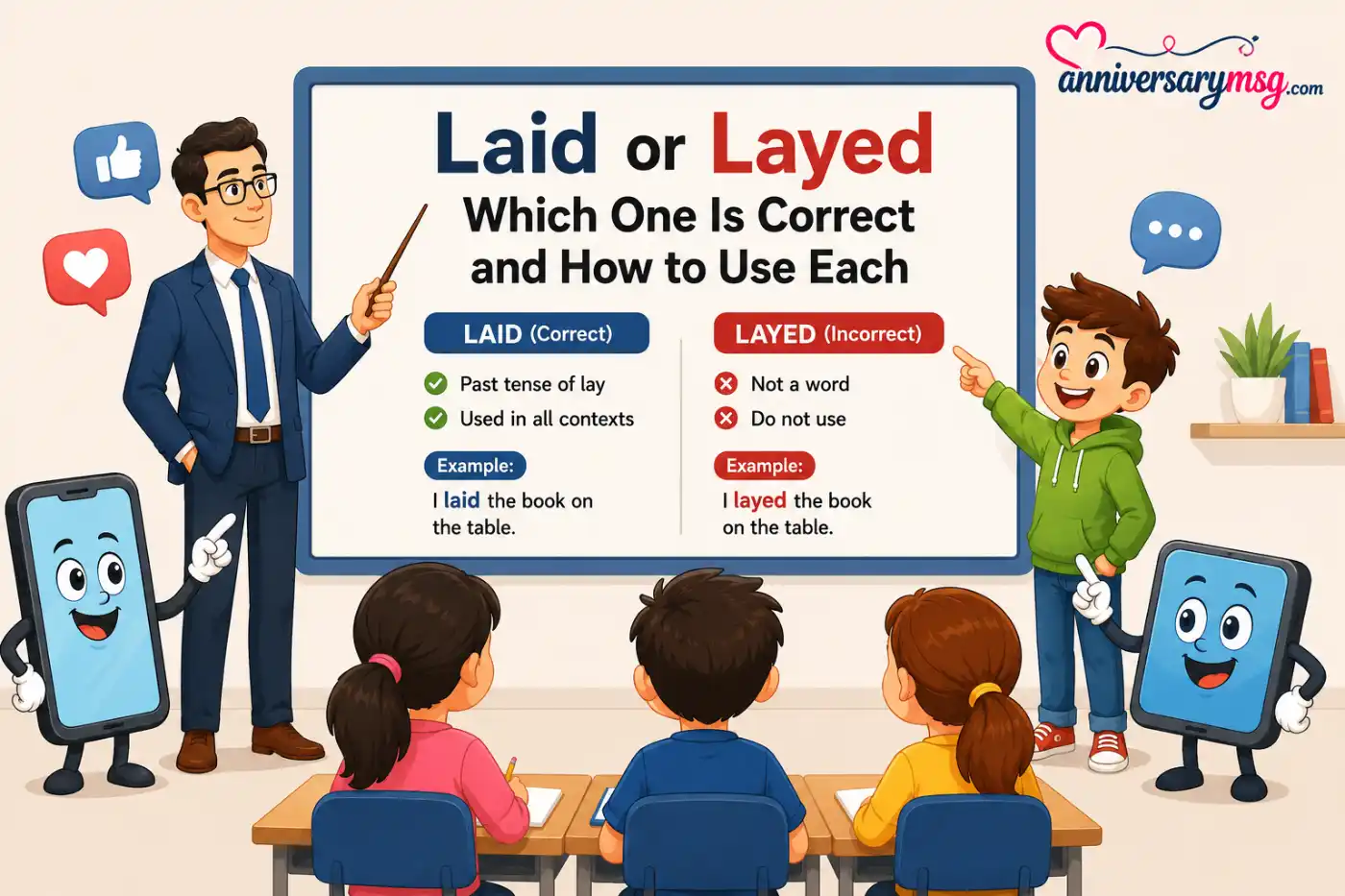
If you are confused about laid or layed, you are not alone. Many English learners see these two spellings and wonder which one is correct. The simple answer is that laid is the standard past tense and past participle of the verb lay. Layed is not the normal form used in modern standard English.
For example, you should write, “She laid the book on the table.” You should not write, “She layed the book on the table.” The word laid is the form you need when someone puts something down.
The confusion becomes bigger because lay, laid, lie, and laying look and sound closely related. They are connected, but they do not all work the same way. Once you learn one simple pattern, the difference becomes much easier to remember.
Simple Answer in One Look of Laid or Layed
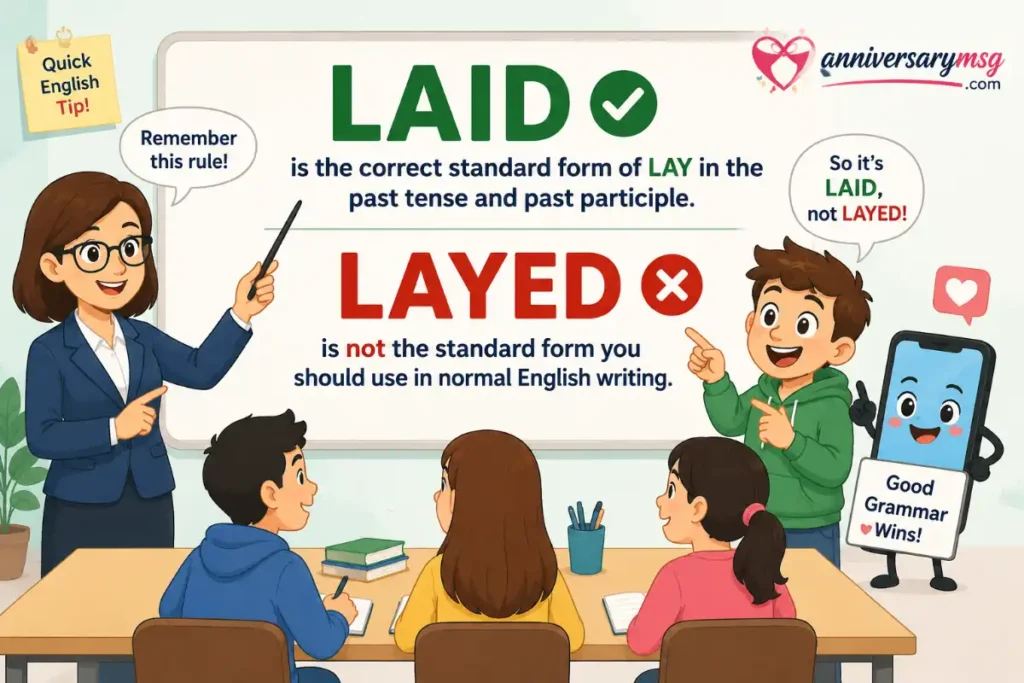
Laid is the correct standard form of lay in the past tense and past participle.
Layed is not the standard form you should use in normal English writing.
For example:
“I lay the keys on the desk every morning.”
“I laid the keys on the desk yesterday.”
Or “I have laid the keys on the desk.”
A quick rule is:
Lay → laid → laid.
So, when you mean that someone put something somewhere, use laid, not layed.
Explore our detailed article on theater or theatre to understand the difference quickly.
What This Means in Simple English of Laid or Layed
The verb lay means to put something down in a place.
For example:
“I lay the book on the desk.”
This means I put the book on the desk.
When you talk about something that already happened, the past form is laid.
“I laid the book on the desk.”
The action happened in the past.
The form laid also works after words such as “have,” “has,” and “had.”
“I have laid the book on the desk.”
“She has laid the baby on the bed.”
“They had laid the papers on the table.”
This is why laid is such an important word to know.
Now you may ask, “Why do people write layed?”
The answer is simple. English has many verbs that add -ed to make the past tense.
For example:
“walk” becomes “walked.”
“play” becomes “played.”
“clean” becomes “cleaned.”
“call” becomes “called.”
So it is easy to think:
“lay” + “ed” = “layed.”
But lay does not follow that simple pattern.
It is an irregular verb.
Its past form is laid.
Think of these examples:
“pay” → “paid”
“say” → “said”
“lay” → “laid”
You cannot always make the past form by adding -ed.
That is one of the main reasons laid or layed causes confusion.
Why People Mix Laid or Layed
The first reason is that layed looks like it should be correct.
When people learn English, they often learn that adding “-ed” can make a verb past tense.
So a person may see:
“lay”
and naturally think:
“layed.”
That sounds logical, but English has many irregular verbs.
The second reason is the confusing relationship between lay and lie.
These words are different verbs, but their forms look very similar.
Here is the basic pattern:
Lay → laid → laid
Lie → lay → lain
This can look strange at first.
For example:
“I lay the book down.”
This means I put the book down.
“I laid the book down yesterday.”
This means I put the book down yesterday.
But:
“I lie on the bed.”
This means I put my own body in a resting position.
In the past:
“I lay on the bed yesterday.”
That single change from lie to lay causes a lot of confusion.
The third reason is that people hear these words often in speech.
When someone says “laid,” a learner may not immediately know how it is spelled.
Then they may write “layed” because it looks more familiar.
The good news is that you only need to remember the standard form.
Layed is not the normal modern English past form of lay.
Use laid.
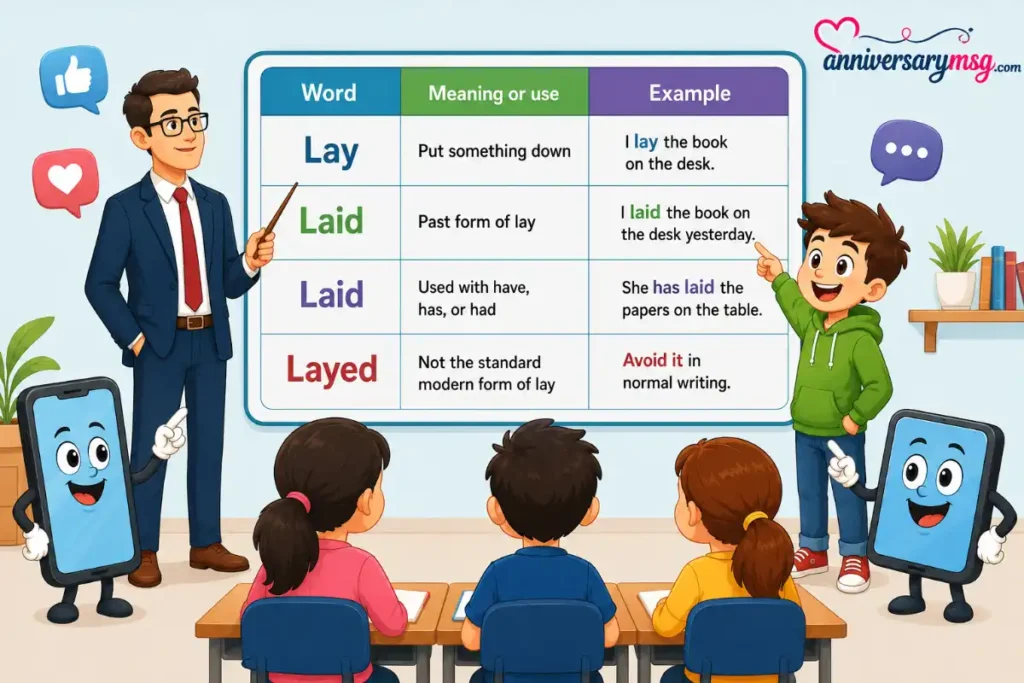
Clear Difference Explained Simply Between Laid or Layed
Here is the easiest comparison.
| Word | Meaning or use | Example |
|---|---|---|
| Lay | Put something down | I lay the book on the desk. |
| Laid | Past form of lay | I laid the book on the desk yesterday. |
| Laid | Used with have, has, or had | She has laid the papers on the table. |
| Layed | Not the standard modern form of lay | Avoid it in normal writing. |
| Lie | Rest or be in a flat position | I lie on the bed. |
| Lay | Past form of lie | I lay on the bed yesterday. |
| Lain | Past participle of lie | I have lain on this bed before. |
The most important pair is:
Lay → laid
Not:
Lay → layed
Here is another simple example.
Present:
“She lays the blanket on the bed.”
Past:
“She laid the blanket on the bed.”
With “has”:
“She has laid the blanket on the bed.”
Notice that laid does not change.
That is an easy pattern to remember.
Which Form Should You Use: Laid or Layed
If you are choosing between laid or layed, choose laid in standard English.
Use laid when the verb means “put something somewhere.”
For example:
“I laid my phone on the table.”
“He laid the baby in the crib.”
“She laid the flowers on the grave.”
“We laid the papers on the desk.”
“They laid the foundation for the house.”
You can also use laid after “have,” “has,” or “had.”
“I have laid the book there.”
“She has laid the clothes on the bed.”
“They had laid the chairs outside.”
The form layed should not be used as the normal past form of lay.
If you see “layed” online, it may be a spelling mistake, a very unusual historical use, or a special word used in a narrow context. For everyday English, school writing, business writing, and standard online content, laid is the safe and correct choice.
So if you are unsure, remember:
I lay something down today.
I laid something down yesterday.
That simple pair will solve most problems.
Easy Real Life Sentences You Can Use
Here are some everyday examples with laid.
- “I laid my keys on the kitchen table.”
- “She laid the baby on the bed.”
- “He laid his jacket on the chair.”
- “We laid the books on the floor.”
- “Mom laid the plates on the table.”
- “I have laid the papers beside your computer.”
- “They laid the flowers near the door.”
- “She laid her phone next to the lamp.”
Each sentence shows the same basic idea.
Someone puts something somewhere.
Now compare the present form.
“I lay my keys on the table every day.”
Yesterday:
“I laid my keys on the table.”
This small change is important.
You should not write:
“I layed my keys on the table.”
Write:
“I laid my keys on the table.”
Laid or Layed in Past Tense
This is one of the most common questions about these words.
The past tense of lay is laid.
It is not layed.
For example:
Present: “I lay the book here.”
Past: “I laid the book here.”
Present: “She lays the clothes on the bed.”
Past: “She laid the clothes on the bed.”
Present: “They lay the bricks carefully.”
Past: “They laid the bricks carefully.”
This may seem unusual because many English verbs use “-ed” in the past.
But irregular verbs have their own past forms.
For example:
“go” becomes “went.”
“take” becomes “took.”
“buy” becomes “bought.”
“pay” becomes “paid.”
“lay” becomes “laid.”
You simply need to learn the form.
Laid or Layed in a Sentence
If you are writing a sentence and are unsure, ask yourself one question:
Does the verb mean put something somewhere?
If the answer is yes and the action happened in the past, use laid.
For example:
“I laid the towel on the chair.”
The towel was placed on the chair.
“She laid the baby in the crib.”
The baby was placed in the crib.
“He laid the money on the counter.”
The money was placed on the counter.
“They laid the books on the desk.”
The books were placed on the desk.
This “put something somewhere” test is very useful.
It gives you a quick way to choose laid without thinking about complicated grammar rules.
Laid or Layed With Have Has and Had
You will often see laid after “have,” “has,” and “had.”
For example:
“I have laid the papers on the desk.”
“She has laid the baby down.”
“They have laid the foundation.”
“He had laid the keys beside the door.”
The word remains laid.
You do not change it to “layed.”
Incorrect:
“She has layed the book on the table.”
Correct:
“She has laid the book on the table.”
Incorrect:
“They had layed the foundation.”
Correct:
“They had laid the foundation.”
This pattern is worth practicing because it appears often in writing.
Where This Word Comes From Simple History
The word lay has a very old history in English.
It comes from older forms of the language and has been used for a very long time to describe putting something down or placing something somewhere.
The past form laid developed as the standard past form of the verb.
English kept many irregular verbs from earlier stages of the language. These verbs do not always follow the simple “add -ed” rule.
That is why we say:
“lay” → “laid”
rather than:
“lay” → “layed.”
The form laid has been used in English for centuries.
The word also appears in many common expressions.
For example:
“laid the groundwork”
“laid the foundation”
Also “laid the table”
“laid the blame”
“laid an egg”
These phrases show how widely the word is used.
The meaning can change slightly depending on the expression, but the spelling remains laid.
A Simple Bridge to Deeper Understanding
The main question is now easy to answer. Laid is the standard past form of lay, while layed is not the normal form you should use in modern standard English.
The bigger challenge is knowing when to use lay, laid, lie, and lain. These words are easy to mix up because they are closely related. Understanding their patterns will help you avoid many common mistakes in everyday English.
How This Word Is Understood in Culture and Stories
The word laid appears in many parts of everyday life.
You may hear it when someone talks about putting something somewhere.
You may also see it in stories.
For example:
“She laid the letter on the table.”
“He laid his coat beside the chair.”
“The workers laid the bricks one by one.”
These sentences are easy to understand because the action is clear.
The word also appears in phrases that have a deeper meaning.
For example:
“She laid the foundation for her career.”
Here, she did not literally put a foundation on the ground. The phrase means she created the basic work needed for future success.
Another example is:
“He laid the groundwork for the project.”
This means he prepared the basic parts of the project.
You may also hear:
“She laid the blame on someone else.”
This means she blamed another person.
The word laid is therefore useful in both simple physical actions and common expressions.
Stories use it often because characters are always putting things down, preparing things, building things, or creating something that leads to another event.
Biblical and Mythological Meaning If Applicable
There is no special biblical or mythological meaning attached to the word laid itself.
It is an ordinary English verb form.
However, the word can appear in religious writing because people in stories often place objects, build structures, or put things in specific places.
For example, a text might describe someone laying a foundation or laying something before another person.
The same basic meaning applies.
There is also no special mythological rule that changes the spelling.
If the verb means “put” and you are talking about a past action, laid is the standard form.
The word may appear in stories about ancient people, heroes, builders, families, or leaders, but the grammar remains the same.
Symbolism Explained in Simple Words
The word laid can sometimes have a symbolic meaning when it appears in an expression.
The basic idea is still connected to putting or placing something.
What One Version Represents
Laid can represent something being placed, started, or prepared.
For example:
“They laid the foundation for the new school.”
The foundation is physical.
But “laid the foundation” can also mean they created the basic plan or support for something important.
Another example is:
“She laid the groundwork for success.”
Here, the person prepared the way for something that would happen later.
So laid can sometimes suggest the beginning of something.
What the Other Version Represents
Layed does not normally represent a separate meaning of laid.
In standard modern English, you should not treat “layed” as the normal alternative spelling.
If you mean the past form of lay, use laid.
This is an important point because learners sometimes assume that two spellings must have two different meanings.
That is not the case here.
The standard pair is:
Lay → laid.
Related Words You Should Know
Learning these related words will make the laid or layed question much easier.
Lay
Lay means to put something somewhere.
“I lay the book on the desk.”
Laid
Laid is the past form of lay.
“I laid the book on the desk.”
Laying
Laying is the form used for an action that is happening or continuing.
“She is laying the books on the table.”
Lie
Lie means to rest or be in a flat position.
“I lie on the couch when I am tired.”
Lay
Lay is also the past form of lie.
“I lay on the couch yesterday.”
This is where many learners get confused.
Lain
Lain is the form used with “have,” “has,” or “had” for the verb lie.
“I have lain on this couch before.”
Placement
Placement means the act of putting something in a particular place.
“The placement of the books was neat.”
Put
Put is a very useful alternative when you are unsure.
“I put the book on the table.”
“Put” has the same form in the present and past.
This makes it easier to use.
How People Actually Use It in Daily English
Here are some natural examples from everyday life.
Putting Down an Object
“I laid my phone on the desk.”
The phone was placed on the desk.
Setting a Table
“She laid the plates on the table.”
The plates were placed where people could use them.
Putting Down Clothes
“He laid his jacket on the bed.”
The jacket was placed on the bed.
Caring for a Baby
“She laid the baby in the crib.”
The baby was placed gently in the crib.
Building Something
“The workers laid the bricks carefully.”
They placed the bricks as part of building a wall.
Preparing a Plan
“She laid the groundwork for the project.”
She prepared the basic work needed for the project.
Making an Egg
“The hen laid an egg.”
This is another common use of laid.
Here, the meaning is not “put something on a table.” The verb is used for producing an egg.
Talking About Blame
“He laid the blame on his teammate.”
This means he blamed his teammate.
These examples show that laid can appear in many different situations.
Laid or Layed With Common Expressions
You will often see laid in common phrases.
One example is laid-back.
“He has a laid-back personality.”
This means he is relaxed and easygoing.
Another is laid off.
“Tom was laid off from his job.”
This means his employer ended his job because the company did not need his position.
Another phrase is laid out.
“She laid out the clothes for tomorrow.”
This means she arranged the clothes so they were ready.
You may also hear laid down.
“He laid down the rules.”
This can mean he clearly stated the rules.
There is also laid the foundation.
“They laid the foundation for the new building.”
This can be literal or figurative.
These phrases are common, so learning laid helps you understand many other expressions.
Common Mistakes People Make
The biggest mistake is writing layed as the past form of lay.
Incorrect:
“I layed the book on the table.”
Correct:
“I laid the book on the table.”
Another common mistake is using laid when you mean lie.
For example:
“I laid on the bed yesterday.”
This is incorrect if you mean that you rested on the bed.
The correct sentence is:
“I lay on the bed yesterday.”
Why?
Because lie means to rest.
Its past form is lay.
Here is the pattern:
Present:
“I lie on the bed.”
Past:
“I lay on the bed.”
With “have”:
“I have lain on the bed.”
Now compare that with lay meaning “put something down.”
Present:
“I lay the book on the bed.”
Past:
“I laid the book on the bed.”
With “have”:
“I have laid the book on the bed.”
This is the key difference.
Lay needs an object.
You lay something somewhere.
Lie does not need an object.
You lie down yourself.
Another mistake is saying:
“I have layed the book here.”
Correct:
“I have laid the book here.”
Another is:
“She has layed the clothes on the bed.”
Correct:
“She has laid the clothes on the bed.”
When you see “have,” “has,” or “had,” remember the correct form is laid for the verb lay.
Lay or Laid When Talking About Today
This is another useful point.
If you are talking about something you regularly do, use lay or lays.
“I lay the newspaper on the table every morning.”
“She lays the clothes on the bed.”
If the action already happened, use laid.
“I laid the newspaper on the table this morning.”
“She laid the clothes on the bed yesterday.”
The time word can help you choose.
Present or regular action:
“every day”
“usually”
“often”
Past action:
“yesterday”
“last night”
“this morning”
“an hour ago”
For example:
“I lay my keys here every day.”
“I laid my keys here yesterday.”
That simple contrast can make the difference much clearer.
How to Avoid the Mistake Forever
Here is a simple classroom trick.
When you want to use lay, imagine the word put.
If you can replace the verb with “put,” you are probably dealing with lay.
For example:
“I put the book on the desk.”
Past:
“I put the book on the desk yesterday.”
Now use the correct form of lay:
“I lay the book on the desk.”
“I laid the book on the desk yesterday.”
The word “put” helps you remember the meaning.
Another trick is to memorize this short line:
Lay it today. Laid it yesterday.
For example:
“I lay the keys here every day.”
“I laid the keys here yesterday.”
Do not try to remember “layed.”
Train your mind to connect:
lay → laid.
Laid or Layed Compared With Other Verb Changes
English has many verbs that change their spelling in unexpected ways.
For example:
“make” becomes “made.”
“take” becomes “took.”
“send” becomes “sent.”
“keep” becomes “kept.”
“pay” becomes “paid.”
“lay” becomes “laid.”
These verbs remind us that English does not always use a simple “-ed” ending.
That is why layed may look reasonable but is not the standard past form.
You can also compare lay with pay.
“pay” → “paid”
“lay” → “laid”
Both words have a similar ending in their past forms.
This can be a helpful memory trick.
Laid or Layed in Formal and Informal Writing
For school work, professional writing, websites, emails, and other standard writing, use laid.
For example:
“The workers laid the foundation.”
“She laid the documents on the desk.”
“He laid the book beside the computer.”
Avoid:
“The workers layed the foundation.”
“She layed the documents on the desk.”
“He layed the book beside the computer.”
The second group contains the common spelling error.
You may encounter unusual uses of layed in old texts or special technical contexts, but that does not change the standard rule for everyday English.
If your goal is clear modern English, choose laid.
Final Teacher Explanation Very Important
If I were writing this on a classroom board, I would make the lesson very small.
First:
LAY = put something somewhere.
Then:
LAID = past form of lay.
Then:
LAYED = do not use as the normal past form.
For example:
Today:
“I lay the book on the table.”
Yesterday:
“I laid the book on the table.”
With “have”:
“I have laid the book on the table.”
That is the first lesson.
Then I would teach the second lesson because this is where many students make a mistake.
LIE = rest.
Present:
“I lie on the bed.”
Past:
“I lay on the bed.”
With “have”:
“I have lain on the bed.”
Now you can see why English learners sometimes get confused.
The word lay belongs to two different patterns.
One pattern is:
lay → laid → laid
This means putting something somewhere.
The other pattern starts with:
lie → lay → lain
This means resting or being in a flat position.
If you remember those two lines, you can solve most questions about these words.
And if you are simply choosing between laid or layed, the answer is much easier.
Choose laid.
For example:
“I laid my phone on the table.”
Not:
“I layed my phone on the table.”
Keep that rule in your head, and you will avoid one of the most common mistakes with this group of English words.
Final Answer Quick Recap of Laid or Layed
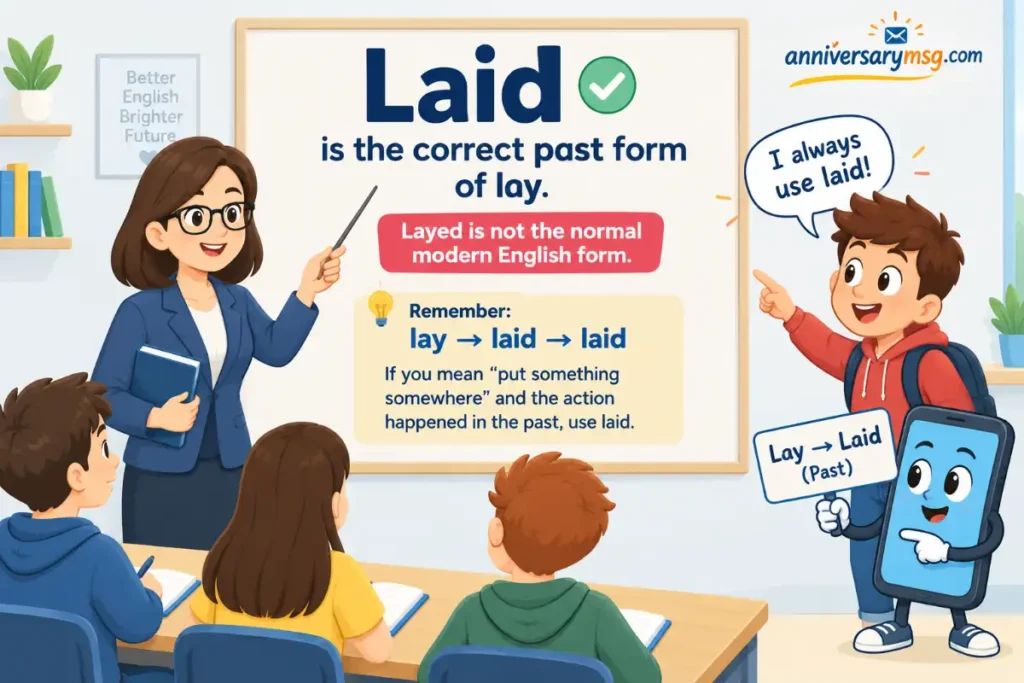
Laid is the correct standard past form of lay. Layed is not the normal modern English form.
Remember: lay → laid → laid. If you mean “put something somewhere” and the action happened in the past, use laid.
Frequently Asked Questions FAQs
Is laid or layed correct?
Laid is the standard correct form of the verb lay. Layed is not normally used in modern standard English.
What is the past tense of lay?
The past tense of lay is laid.
For example: “I laid the book on the table.”
Is layed a real word?
You may find layed in rare, old, or special uses, but it is not the standard past form of lay. Use laid in normal English.
What is the difference between lay and laid?
Lay is the present form when you put something somewhere. Laid is the past form.
“I lay the book down.”
“I laid the book down yesterday.”
Should I say I laid down or I lay down?
If you mean that you rested yourself, use lie in the present and lay in the past.
“I lie down every night.”
“I lay down yesterday.”
Is it I layed on the bed or I lay on the bed?
The correct sentence is “I lay on the bed.” Here, lay is the past form of lie.
How do I remember laid vs layed?
Remember this simple pattern: lay → laid. Think, “I lay it today, but I laid it yesterday.”
What is the difference between lay and lie?
Lay means to put something somewhere. Lie means to rest or be in a flat position.
“I lay the book down.”
“I lie on the bed.”

Ryan is a creative writer and relationship content specialist who believes in the power of meaningful words. He focuses on anniversaries, love notes, and memorable messages that make people feel connected. When not writing, Ryan loves kayaking, attending live jazz performances, and collecting vintage postcards from his travels.