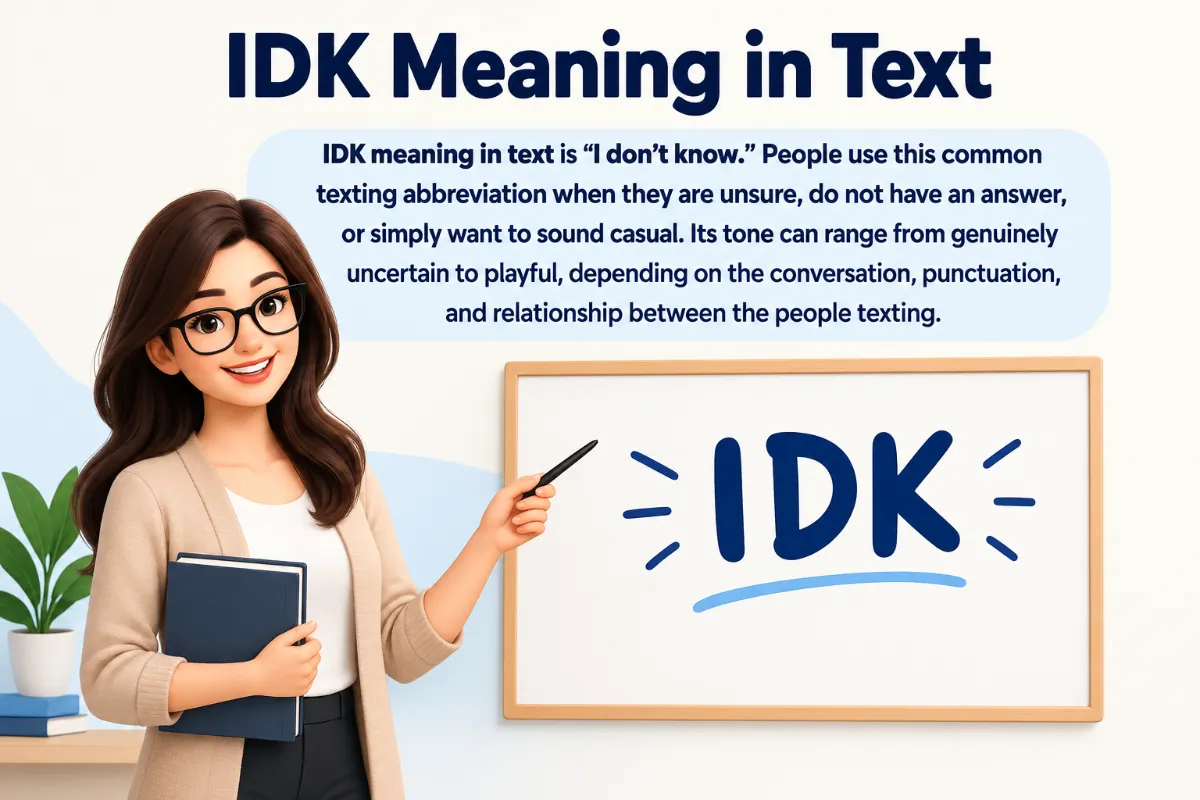
IDK meaning in text is “I don’t know.” People use this common texting abbreviation when they are unsure, do not have an answer, or simply want to sound casual. Its tone can range from genuinely uncertain to playful, depending on the conversation, punctuation, and relationship between the people texting.
IDK is one of the most common internet and texting abbreviations. You may see it in texts, social media comments, direct messages, gaming chats, and casual online conversations.
The abbreviation usually keeps a conversation short and relaxed. Instead of typing “I don’t know,” someone can simply write “IDK” and move on.
The exact tone depends on context. A short “idk” may show uncertainty, while “IDK 😂” can sound playful or humorous.
IDK Meaning in Text at a Glance
| Category | Meaning |
|---|---|
| Part of speech | Abbreviation or initialism |
| Definition | I don’t know |
| Language of origin | English |
| Context of use | Texting, social media, chats, and informal communication |
| Pronunciation | Usually read as “I-D-K” |
What Does It Mean
The simple IDK meaning in text is I don’t know. Someone uses it when they lack information, cannot decide, or do not want to give a definite answer.
For example, if a friend asks, “What time does the movie start?” you might reply, “IDK, check the website.” In this case, the person is simply saying they do not have the information.
IDK can also express uncertainty about feelings or plans. A message such as “IDK what I want to do tonight” usually means the person has not made a decision yet.
The abbreviation does not automatically mean someone is annoyed, uninterested, or ignoring you. The surrounding conversation matters more than the three letters themselves.
Deeper Meaning and Significance
IDK looks simple, but its tone can change based on the situation. It can communicate honest uncertainty, hesitation, casual indifference, or playful confusion.
Primary Meaning
The primary meaning is I don’t know. It directly tells the reader that the sender does not know the answer or has not reached a conclusion.
For example:
“I asked Sarah about the party, but IDK if she is coming.”
Here, IDK simply replaces the longer phrase “I don’t know.”
Secondary Meaning
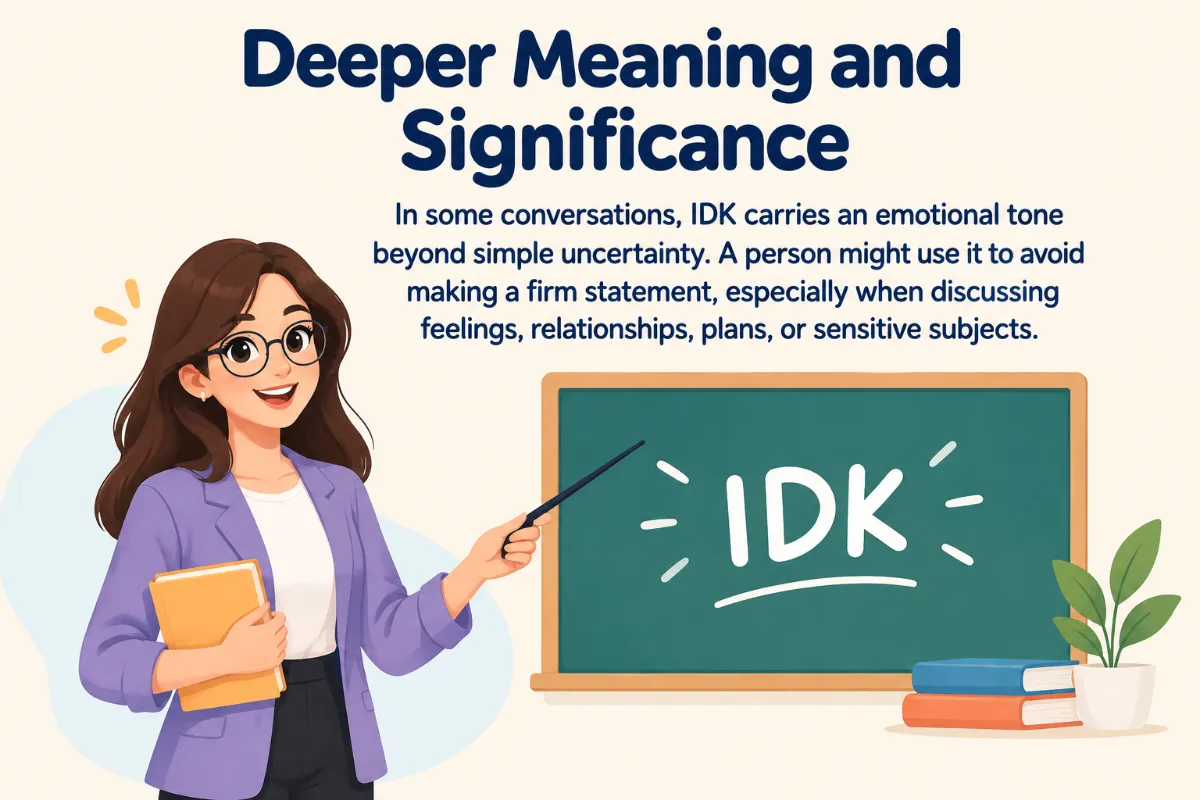
In some conversations, IDK carries an emotional tone beyond simple uncertainty. A person might use it to avoid making a firm statement, especially when discussing feelings, relationships, plans, or sensitive subjects.
For instance, someone replying “idk 😭” may not be completely clueless. They could be confused, embarrassed, undecided, or joking about the situation.
This is why the IDK meaning in text from a guy or from a girl cannot be understood from the abbreviation alone. Their previous messages, wording, punctuation, and the subject of the conversation provide more useful clues.
Origin and Etymology
IDK developed as a shortened form of the English phrase I don’t know. It follows a common pattern in digital communication where people take the first letters of words to create quick abbreviations.
Historical Background
Texting abbreviations became especially common as mobile phones, instant messaging, chat rooms, and social media grew. Short forms helped people communicate quickly when typing was less convenient.
IDK became part of this larger collection of internet slang alongside terms such as LOL, BTW, OMG, and BRB.
Language Roots
The phrase comes directly from English. The letters represent:
I = I
D = don’t
K = know
Unlike a traditional word, IDK is an initialism because people normally pronounce its individual letters rather than saying it as one spoken word.
Evolution of the Term
IDK moved from early online chats and text messaging into everyday digital communication. Today, people use it across social media, messaging apps, gaming communities, and casual conversations.
Its lowercase form, “idk,” is also common. Lowercase writing often gives the message a relaxed and informal feel.
Examples in Sentences
IDK works best in casual communication where abbreviations feel natural. Here are some examples that show how its tone can change.
Real Life Examples
- “IDK what time the store closes, so I’ll check.”
- “idk, maybe we should try the new restaurant.”
- “IDK why I laughed so hard at that joke.”
Everyday Usage
In everyday texting, IDK can replace “I don’t know” without changing the basic meaning. The difference is mainly in tone and formality.
A message like “I don’t know” may sound more complete or serious, while “idk” usually feels quicker and more casual.
People also combine IDK with emojis, punctuation, or other slang. For example, “idk 😂” can suggest amusement, while “IDK?” may show confusion or uncertainty.
Synonyms and Related Terms
Several phrases can communicate a similar idea, but their tone differs.
I don’t know: The standard full phrase. It works in both casual and more formal situations.
Not sure: Often sounds softer and less direct than IDK.
No idea: A casual way to say you have no information.
I’m unsure: More polished and suitable for professional communication.
Dunno: Very informal and conversational. It can sound relaxed or playful.
IDC: Means “I don’t care,” which is different from IDK. One expresses uncertainty, while the other expresses a lack of concern.
Understanding the difference between IDK and IDC matters because the two abbreviations can create very different impressions.
Meaning in Different Contexts
The meaning stays connected to “I don’t know,” but the tone can change across different settings.
Social Communication
Friends often use IDK when discussing plans, opinions, gossip, entertainment, or everyday questions. It keeps the conversation quick and informal.
Cultural Contexts
Internet slang has become a normal part of modern digital culture. Abbreviations such as IDK allow people to communicate in a fast, compact style that reflects casual online conversation.
Professional or Technical Fields
IDK is generally not appropriate for formal reports, business emails, academic writing, or technical documents. In those settings, phrases such as “I’m not sure” or “I don’t have that information” are clearer and more professional.
Media or Literature
Writers sometimes use IDK in dialogue to make a character’s text messages feel realistic. It can help show that a character is young, casual, uncertain, humorous, or comfortable with internet slang.
Cultural or Symbolic Significance
IDK has become more than a simple abbreviation because digital communication often relies on short forms to express tone quickly. Its widespread use reflects how texting has changed everyday English.
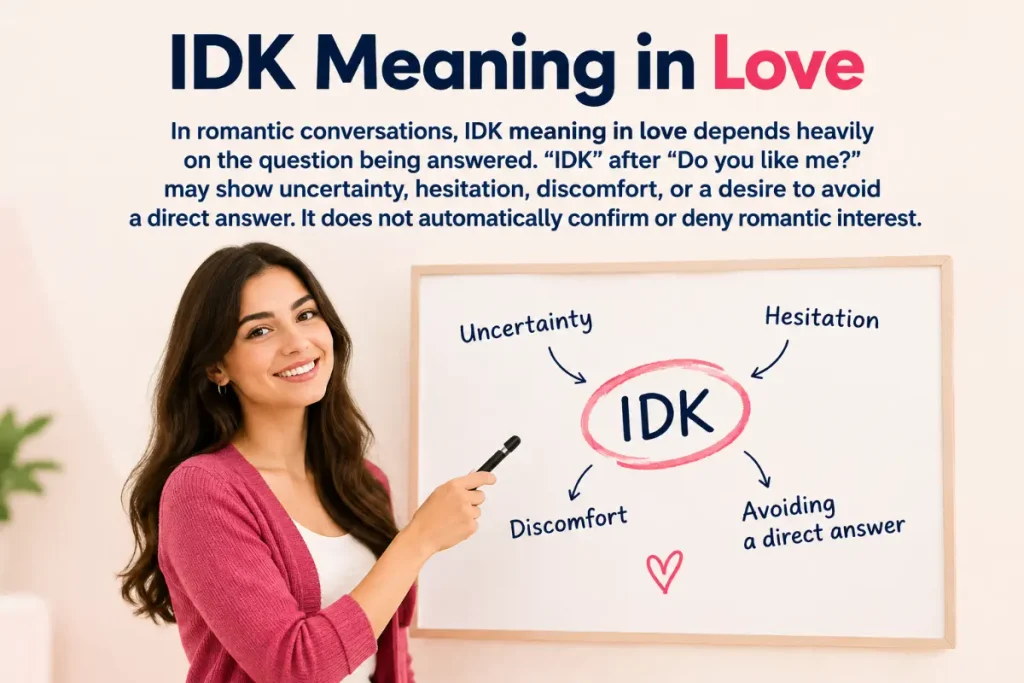
In romantic conversations, IDK meaning in love depends heavily on the question being answered. “IDK” after “Do you like me?” may show uncertainty, hesitation, discomfort, or a desire to avoid a direct answer. It does not automatically confirm or deny romantic interest.
The same applies to IDK meaning from a girl or IDK meaning from a guy. The abbreviation itself does not have a special gender-specific meaning.
IDK can also appear in funny conversations. Someone might write “IDK 😂” after an absurd question to make their uncertainty sound intentionally humorous.
When someone asks about the IDK meaning in text from a guy, the safest way to understand it is to look at the complete exchange rather than assigning a hidden meaning to the abbreviation.
Conclusion
The IDK meaning in text is simply “I don’t know.” It is a casual English abbreviation used in texting, social media, messaging apps, gaming, and other informal conversations.
Its tone can change with the situation. IDK may show genuine uncertainty, hesitation, confusion, or humor, so the surrounding words and conversation provide important context.
Remember that IDK and IDC have different meanings. IDK expresses uncertainty, while IDC means “I don’t care.” Using the right abbreviation helps keep digital conversations clear.
FAQs
IDK means “I don’t know,” while IDC means “I don’t care.” Both are common texting abbreviations, but they express different attitudes.
TBH means “to be honest,” while IDK means “I don’t know.” Together, they usually show that she is being honest while expressing uncertainty or hesitation.
IDEK means “I don’t even know.” It usually expresses stronger confusion, uncertainty, surprise, or frustration than simply saying IDK.
No. LMAO commonly means “laughing my ass off” and is used to show strong amusement. It is not normally used to mean “lick me all over.”
LMBO usually means “laughing my butt off.” It is a softer variation of LMAO and generally means that she finds something very funny.

Ryan is a creative writer and relationship content specialist who believes in the power of meaningful words. He focuses on anniversaries, love notes, and memorable messages that make people feel connected. When not writing, Ryan loves kayaking, attending live jazz performances, and collecting vintage postcards from his travels.



1 thought on “IDK Meaning in Text”