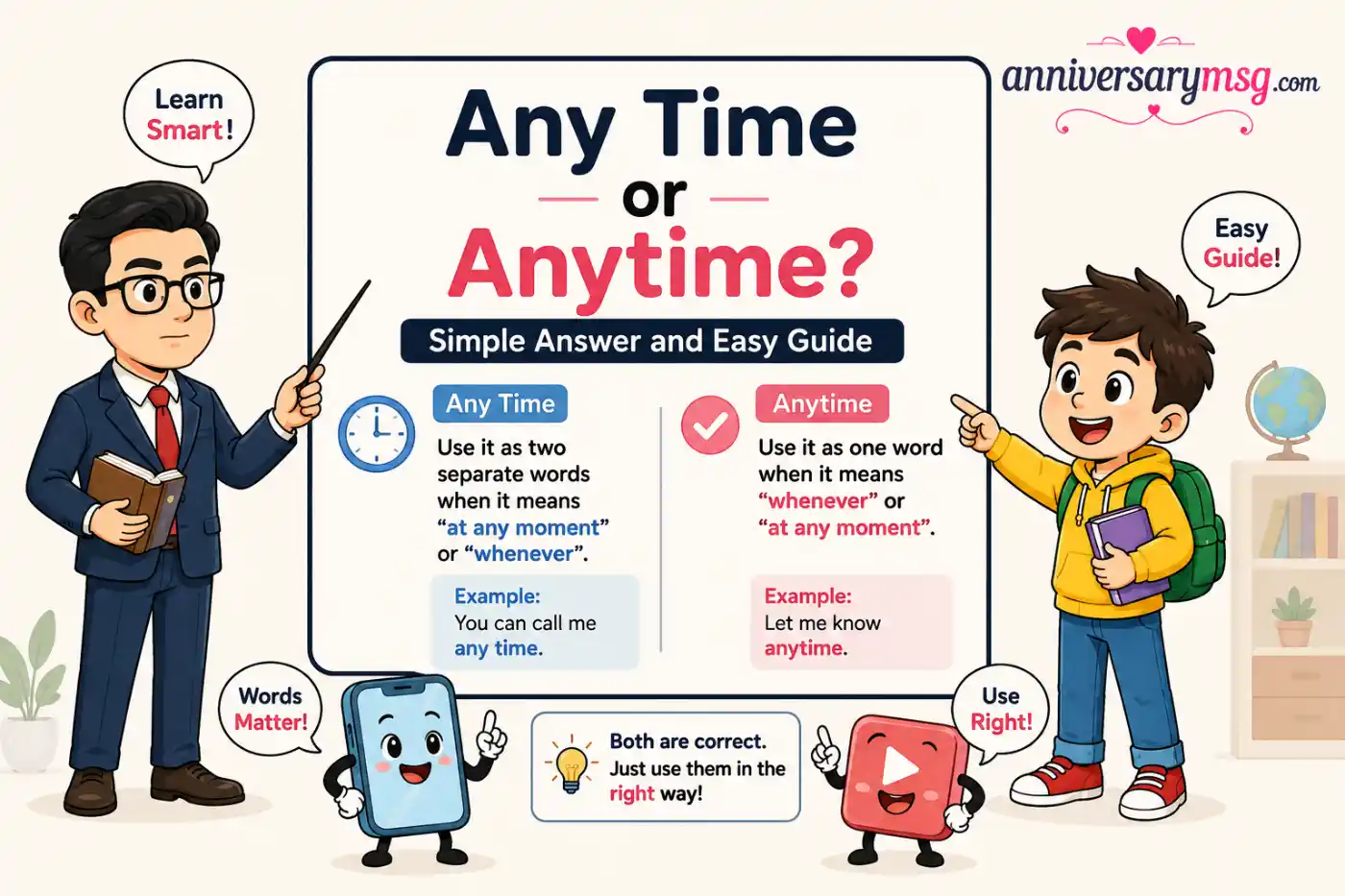
Many students ask this question: any time or anytime—which one is correct? These two look very similar. They sound the same when we speak. That is why many learners feel confused.
The good news is simple. Both any time and anytime are correct. But they are used in different ways. This is very important to understand.
In this lesson, I will explain any time or anytime step by step. I will teach you like in a classroom using very simple English. By the end, you will know exactly when to use each one.
Simple Answer in One Look
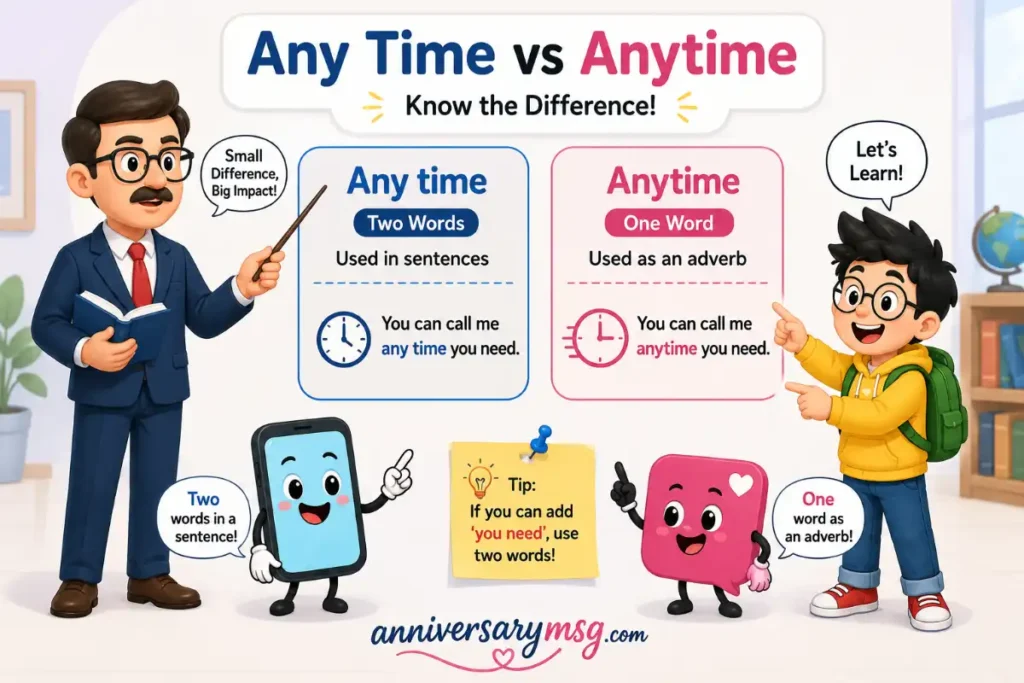
Any time = used in sentences (two words)
Anytime = used as an adverb (one word)
Build your grammar skills with anyway vs anyways.
What This Means in Simple English
Let me explain this in a very easy way.
The phrase any time (two words) means “at any moment” or “whenever you want.”
Example:
You can call me at any time.
Now look at anytime (one word). It also means “whenever,” but it is used differently in a sentence.
Example:
You can call me anytime.
Both sentences mean the same thing. But the structure is different.
Here is the simple idea:
👉 Use any time when you use a preposition like “at”
👉 Use anytime when you do not need “at”
Why People Mix These Words
Students get confused about any time or anytime for a few simple reasons.
First, both forms sound exactly the same. So when you speak, you cannot tell the difference.
Second, both forms can appear in similar sentences.
For example:
Call me at any time.
Call me anytime.
Both are correct. This makes it harder to see the rule.
Third, many people do not learn the small grammar difference. So they use one form everywhere.
But now you will learn the clear rule.
Clear Difference Explained Simply
Let us make this very easy.
- Any time → two words
Used with words like “at”
Example: at any time - Anytime → one word
Used alone as an adverb
Example: call me anytime - Both mean the same thing
- The difference is how they are used in a sentence
Which Form Should You Use?
Here is the simple rule I teach my students.
Use any time when you say “at any time.”
Example:
You can visit at any time.
Use anytime when you do not use “at.”
Example:
You can visit anytime.
Both are correct. Just follow the sentence structure.
If you are not sure, you can always use any time. It works in all formal writing.
Easy Real-Life Sentences You Can Use
Using any time:
You can call me at any time.
I am free at any time today.
Come to my house at any time.
You can ask for help at any time.
She can arrive at any time.
Using anytime:
You can call me anytime.
Visit us anytime.
I am ready anytime.
Come anytime you want.
She can come anytime.
As you can see, both are easy to use.
Where This Word Comes From (Simple History)
In the past, people used any time as two words.
Over time, the word anytime became popular in casual English. It became a shorter and faster way to say the same thing.
Now both forms are accepted. But we still follow simple rules when we write.
How This Word Is Understood in Culture and Stories
The words any time and anytime are used in daily life to show openness and kindness.
When someone says, “You can call me anytime,” it means they are always ready to help. It feels friendly and warm.
In stories, this phrase shows trust. It means the person is always there for you.
For example:
You can come anytime. I will be here.
This makes the sentence feel simple and welcoming.
Biblical and Mythological Meaning (If Applicable)
In many old stories and teachings, people talk about being ready to help at any moment.
This idea is similar to any time or anytime. It shows readiness and support.
For example, a helper or guide is always there “at any time.” This means they are always available.
So the meaning is about being open and ready.
Symbolism Explained in Simple Words
What One Version Represents
Any time (two words) often feels a bit more formal. It is used in clear and complete sentences.
It represents exact time or moment.
What the Other Version Represents
Anytime (one word) feels more casual and friendly.
It represents ease and comfort. It sounds more natural in daily speech.
So both show the same idea, but the tone can feel slightly different.
Related Words You Should Know
Here are some simple related words:
Whenever
Means at any moment.
Always
Means all the time.
At all times
Means every moment without stop.
Free time
Time when you are not busy.
Available
Ready to do something.
These words help you understand the idea better.
How People Actually Use It in Daily English
People use any time and anytime in many simple ways.
Here are real-life examples:
Call me anytime you need help.
You can visit at any time.
I am free anytime today.
She can arrive at any time.
Come anytime you feel bored.
Help is available at any time.
You can ask questions anytime.
He can join us at any time.
You can message me anytime.
Support is there at any time.
These are simple and natural sentences.
Common Mistakes People Make
Let me help you avoid mistakes with any time or anytime.
Mistake 1: Using anytime after “at”
Wrong:
You can come at anytime.
Correct:
You can come at any time.
Mistake 2: Always using one form
Some people only use “anytime” or only “any time.” This is not correct.
You need to choose based on the sentence.
Mistake 3: Thinking both are always the same
They mean the same thing, but the structure is different.
Mistake 4: Forgetting the simple rule
Just remember:
👉 “at any time” (two words)
👉 “anytime” (one word, no “at”)
Final Teacher Explanation (Very Important)
Let me explain this like I would in class.
You asked: any time or anytime?
Here is the simple answer.
Both are correct. But they are used in different ways.
Use any time when you say “at any time.”
Use anytime when you do not use “at.”
That’s it. No hard rules. No confusion.
Just remember this one idea, and you will always be correct.
Final Answer (Quick Recap)
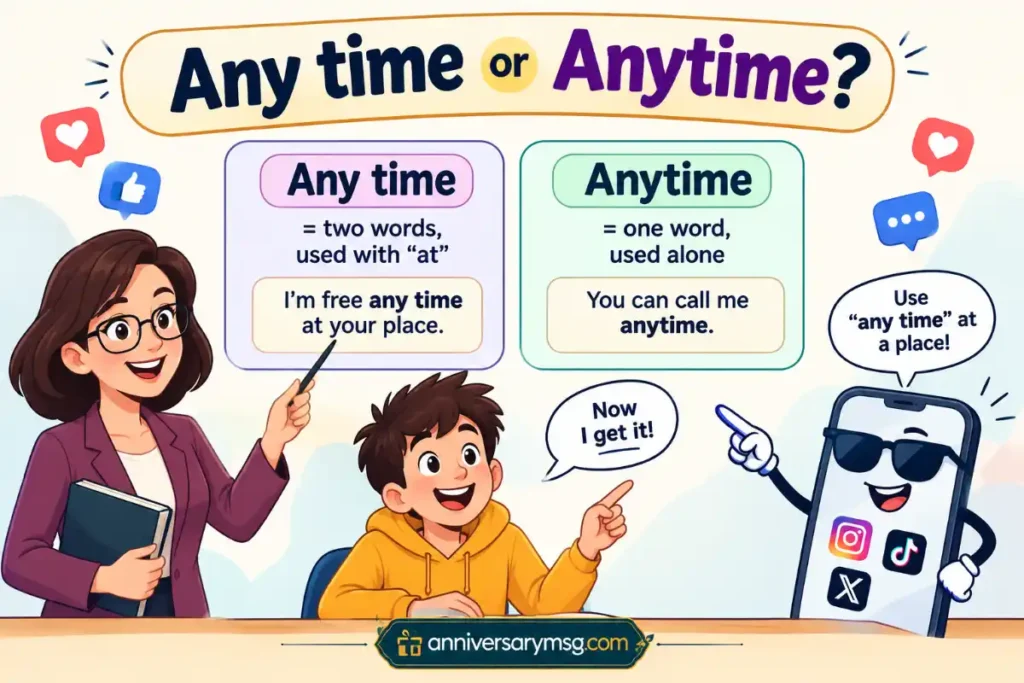
Any time = two words, used with “at”
Anytime = one word, used alone
Both mean the same thing
Use the right form based on the sentence
Conclusion
Now you clearly understand the answer to any time or anytime. These two forms may look confusing at first, but the rule is very simple once you learn it. Both are correct, and both have the same meaning. The only difference is how they are used in a sentence. When you see “at,” you should use any time. When there is no “at,” you can use anytime.
The best way to learn this is through practice. Try using both forms in your daily sentences. Read simple English and notice how these words are used. Over time, this will feel natural to you. You will not need to stop and think. You will just know which one to use, like a real English speaker.
Frequently Asked Questions (FAQs)
What does any time mean in simple words?
It means at any moment.
Is anytime correct?
Yes, it is correct when used without “at.”
When should I use any time?
Use it after “at,” like “at any time.”
When should I use anytime?
Use it without “at,” like “call me anytime.”
Why do people get confused?
Because both sound the same and have similar meaning.
Can I use anytime in formal writing?
Yes, but “any time” is safer in formal use.
Do both mean the same thing?
Yes, both mean “whenever.”

Ryan is a creative writer and relationship content specialist who believes in the power of meaningful words. He focuses on anniversaries, love notes, and memorable messages that make people feel connected. When not writing, Ryan loves kayaking, attending live jazz performances, and collecting vintage postcards from his travels.