If you’re confused about fliers vs flyers, you’re not alone. Both spellings are correct in English, but they can be used in different ways. The word you choose can depend on what you mean and, in some cases, what kind of English you are writing.
The easiest rule is this. Flyer is very common when you mean a small printed paper used to advertise an event, product, sale, or service. Flier can also mean that, especially in American English, but it is often used for a person or thing that flies.
For example, a business might hand out flyers for a grand opening. A person who travels by plane can be called a flier. Still, English has some overlap here, so you may see flyer used for both meanings too. Understanding the small difference will help you choose the spelling that fits your sentence.
Simple Answer in One Look of Fliers vs Flyers
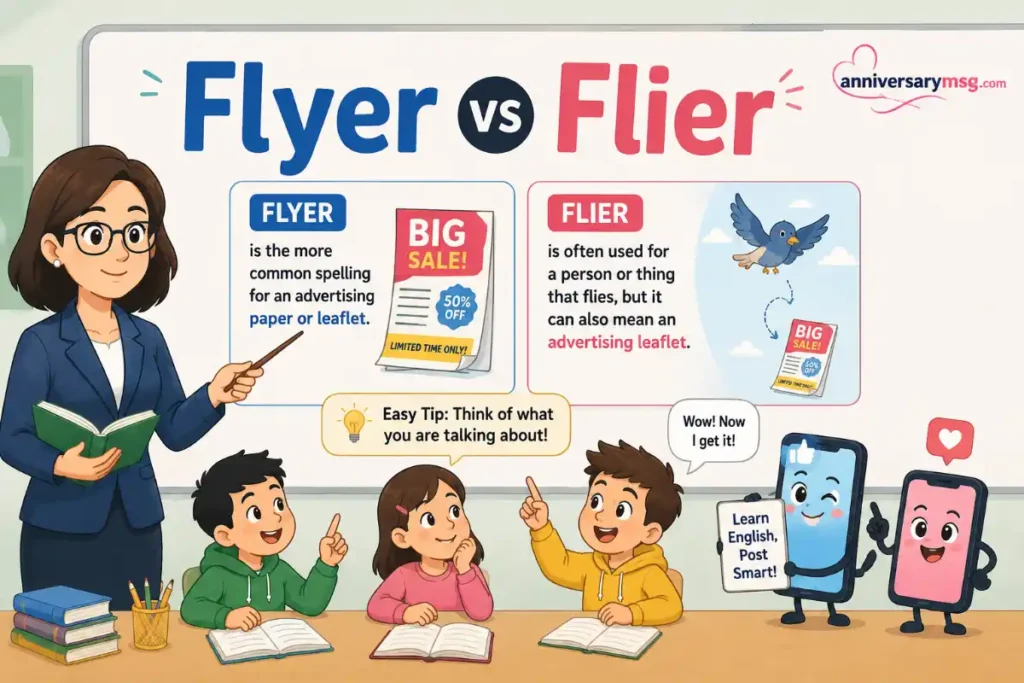
Flyer is the more common spelling for an advertising paper or leaflet.
Flier is often used for a person or thing that flies, but it can also mean an advertising leaflet.
Both spellings can be correct. The sentence’s meaning and style help you choose.
If this topic interests you, our laid or layed article explains everything step by step.
What This Means in Simple English
Think of fliers vs flyers as two spellings of closely related words.
They look almost the same. They sound the same in normal speech. That is why people often get confused when they see them in writing.
The main difference becomes clearer when you look at what the word describes.
A flyer is often a piece of paper that gives information about something.
For example:
“Someone gave me a flyer for the school concert.”
The paper might have the date, time, location, and ticket information.
You could also see a flyer for a restaurant.
“There’s a flyer for a new pizza place on the table.”
A flier can describe someone who flies.
For example:
“She is a frequent flier.”
This means she travels by plane often.
The spelling flyer can also be used for a person who flies. So you may see:
“She is a frequent flyer.”
That sentence is also common.
This is why fliers vs flyers is not a simple case of one spelling being right and the other being wrong.
Both forms have a place in English.
The important thing is to understand the most common patterns.
When talking about advertising material, flyer is usually the safest choice.
When talking about someone who flies often, both flier and flyer can appear, although frequent flyer is a very common fixed phrase in American English.
Here is a simple way to think about it.
Flyer often points to a paper or advertisement.
Flier often points to a person or thing that flies.
But the two forms overlap.
That overlap is the main reason this spelling question can feel confusing.
Why People Mix These Words
People mix up flier and flyer because they have almost the same spelling and the same pronunciation.
When you hear someone say the word, you cannot tell which spelling they mean.
Imagine someone says:
“I got a flyer at the store.”
You hear the word, but you don’t know if the speaker would write it as flyer or flier.
This happens with many English words.
English has many words that sound the same but have different spellings. It also has words where two spellings are accepted.
Flier and flyer belong to this second group.
Another reason for the confusion is that both spellings have been used for advertising papers.
You may see:
“Free pizza flyer.”
You may also find:
“Free pizza flier.”
The first version is much more common in modern American English.
This doesn’t mean the second version is automatically wrong.
It simply means flyer is the spelling most readers are likely to expect for promotional material.
The same thing happens with travel.
You may hear:
“She’s a frequent flyer.”
This is a very familiar phrase in American English.
But frequent flier is also found in dictionaries and real writing.
That means learners should not think of the two spellings as enemies.
They are more like close relatives.
They share the same basic history and pronunciation. In modern use, their have some differences between fliers vs flyers.
Clear Difference Explained Simply
The difference between fliers vs flyers is easiest to understand with examples.
| Spelling | Common meaning | Example |
|---|---|---|
| Flyer | An advertising paper | “I picked up a flyer for the sale.” |
| Flyer | A person who flies | “He’s a frequent flyer.” |
| Flier | A person who flies | “She’s a frequent flier.” |
| Flier | An advertising paper | “They handed out fliers downtown.” |
| Flyer | Something that flies | “The bird is a fast flyer.” |
| Flier | Something or someone that flies | “The eagle is an excellent flier.” |
The table shows why the answer isn’t simply “use one spelling and never use the other.”
Both spellings can be correct.
However, there are some useful preferences.
For an advertising paper, flyer is usually the best choice.
For someone who flies, flier can be useful, but flyer is also very common.
For example:
“Please read the flyer.”
This almost always means a printed advertisement or information sheet.
Now look at:
“My dad is a frequent flyer.”
Here, the word describes someone who travels by air often.
The meaning comes from the context.
That is an important lesson for English learners.
You cannot always understand an English word from its spelling alone.
Sometimes the words around it tell you what it means.
Which Form Should You Use
If you’re writing about an advertisement, use flyer.
For example:
“The store printed 5,000 flyers.”
“The school sent home a flyer.”
“I found a flyer about the concert.”
“The restaurant gave us a flyer.”
This is the safest and most familiar choice for American readers.
If you’re talking about someone who flies, you can use flier or flyer.
For example:
“She is a frequent flier.”
“She is a frequent flyer.”
Both can be understood.
However, frequent flyer is especially common in American English. You will see it often in travel programs, airline information, and everyday writing.
So if you want the most familiar American expression, frequent flyer is a strong choice.
You can also use flyer for things that fly.
For example:
“That bird is a strong flyer.”
A person who flies a plane can be called a flyer in some contexts, but words such as pilot are usually clearer when you mean the person operating an aircraft.
The best rule is not to worry about making a perfect choice every time.
Think about your meaning first.
Are you talking about a piece of advertising?
Use flyer.
Are you talking about a person who flies?
Flier and flyer can both work.
Are you using the familiar travel phrase?
Frequent flyer is very common.
Easy Real Life Sentences You Can Use
Here are some simple sentences that show how the words work.
“I found a flyer for a weekend sale.”
“The school sent home a flyer about the event.”
“They handed out flyers near the mall.”
“My sister is a frequent flyer.”
“My sister is a frequent flier.”
“That bird is a fast flyer.”
“That bird is a strong flier.”
“Please put the flyers on the front desk.”
These examples show that context matters.
If the sentence talks about a sale, concert, restaurant, class, or event, flyer probably means a printed advertisement.
If the sentence talks about travel, airplanes, or someone who flies often, flier or flyer may describe the person.
Where These Words Come From
Both words come from the verb fly.
The word fly is very old in English. It can describe moving through the air.
A bird can fly.
An airplane can fly.
A person can fly in an airplane.
Over time, English began using forms such as flier and flyer for someone or something connected with flying.
The spelling flyer also became widely used for a printed piece of advertising.
Why did a paper become called a flyer?
The idea is connected to something that is passed around quickly.
A flyer can move from one person’s hand to another.
Businesses can hand flyers to many people in a short time.
The word became common for these small printed advertisements.
Today, flyer is a very familiar word for this type of paper.
The history also helps explain why both spellings still exist.
English spelling is not always perfectly regular. Different spellings can survive for a long time.
That is why you should not assume that one spelling must be wrong just because another spelling is more common.
A Simple Bridge to Real World English
Now the basic difference should feel much easier. The next step is seeing how Americans actually use these words in everyday life.
You may find them in stores, schools, airports, advertisements, websites, travel programs, and casual conversations. The spelling you choose can change slightly depending on the meaning, but the context usually makes the answer clear.
How This Word Is Understood in Culture and Stories
The word flyer is common in American daily life because advertising is everywhere.
You may see flyers at a coffee shop.
You may see them at a school.
You may find one on a community bulletin board.
A local business may put flyers in nearby homes.
A flyer might advertise a yard sale, music show, fitness class, restaurant opening, or community event.
For many Americans, a flyer simply means a small piece of printed information.
For example:
“There’s a flyer for the farmers market on the wall.”
Everyone understands that the paper gives information about the event.
The word also appears in stories and conversations about travel.
Someone might say:
“My brother is a frequent flyer.”
This means he travels by plane often.
The phrase can also connect to airline reward programs.
A person who travels often may earn miles or points through a frequent flyer program.
This is one reason flyer is especially familiar to American readers.
You may also see flier in books, newspapers, websites, and other writing.
For example:
“She was a bold flier.”
That sentence focuses on the person’s willingness or ability to fly.
The word can also describe an animal.
“That eagle is an impressive flier.”
Again, context tells you the meaning.
So in everyday American culture, both spellings are useful. Flyer is especially common for advertising material and the familiar phrase frequent flyer.
Biblical and Mythological Meaning
There is no special biblical or mythological meaning for flier or flyer.
These are ordinary English words.
You may find stories about birds, angels, gods, heroes, or other beings that fly. But that does not give the words themselves a special religious meaning.
The word flyer can simply describe something that flies.
The word flier can also describe something or someone that flies.
In a story about a mythical creature, a writer might say:
“The creature was a powerful flyer.”
Or:
“The creature was a powerful flier.”
The meaning is still simple.
The creature can fly.
There is no hidden message in the spelling.
This is useful to remember because not every word difference has a cultural or symbolic meaning. Sometimes the difference is simply about spelling, usage, and context.
Symbolism Explained in Simple Words
These two spellings do not have fixed symbolic meanings.
Still, the ideas connected with flying can have different meanings in stories and everyday speech.
What One Version Represents
Flier can bring attention to the person or creature doing the flying.
For example:
“He is a brave flier.”
The focus is on the person and their ability to fly.
In a story, a flier might be someone who takes risks, travels far, or enjoys the freedom of the sky.
But these ideas come from the story itself, not from the spelling flier.
The spelling does not automatically mean bravery or freedom.
What the Other Version Represents
Flyer can often bring attention to something that moves through the air or to a printed advertisement.
For example:
“The eagle is an excellent flyer.”
Here, the word describes the eagle’s ability to fly.
But:
“The store made a flyer.”
Now the word means a piece of advertising.
This shows how strongly context controls meaning.
The same spelling can have more than one meaning.
That is normal in English.
Related Words You Should Know
Learning a few related words makes fliers vs flyers much easier.
Fly
Fly is the basic verb.
For example:
“Birds fly south in winter.”
Flying
Flying describes the action of moving through the air.
For example:
“Flying can be exciting.”
Flyer
A flyer can be a person or thing that flies. It can also be a printed advertisement.
For example:
“She is a frequent flyer.”
Or:
“I picked up a flyer.”
Flier
A flier can describe a person or thing that flies.
For example:
“He is an experienced flier.”
It can also mean an advertising paper.
Frequent Flyer
A frequent flyer is someone who travels by airplane often.
For example:
“My uncle is a frequent flyer.”
This is one of the most common phrases using flyer.
Leaflet
A leaflet is a small printed paper that gives information or advertises something.
For example:
“They gave me a leaflet about the class.”
In American English, flyer is often used for this same idea.
Handout
A handout is something given to people, often on paper.
For example:
“The teacher gave us a handout.”
A handout and a flyer can look similar, but they usually have different purposes.
Advertisement
An advertisement is something that promotes a product, service, event, or business.
A flyer can be one type of advertisement.
How People Actually Use It in Daily English
Let’s look at more natural examples.
At a Store
“Did you see the flyer for the weekend sale?”
Here, flyer means a printed advertisement.
At School
“The teacher sent a flyer about the school picnic.”
Again, the word means an information sheet.
At a Restaurant
“They left flyers on every table.”
The restaurant is using printed papers to promote something.
At an Event
“I got a flyer for the concert.”
The flyer gives information about the concert.
At an Airport
“My dad is a frequent flyer.”
Here, flyer means someone who travels by plane often.
Talking About Travel
“She is a regular flier.”
Here, flier describes a person who flies often.
Talking About Birds
“That eagle is an amazing flyer.”
The word describes an animal that flies.
Talking About Birds With the Other Spelling
“That eagle is a strong flier.”
This also works.
Talking About Business
“We need more flyers for the new store.”
The meaning is clear from the word “store.”
Talking About a Person
“He’s an experienced flier.”
The meaning is clear because the sentence describes a person’s flying experience.
These examples show a simple lesson.
Context is your friend.
If you understand the words around flier or flyer, you can usually understand the meaning quickly.
Common Mistakes People Make
One common mistake is thinking that flier is always wrong.
It isn’t.
Flier is a real English spelling.
For example:
“She is a frequent flier.”
That sentence can be correct.
Another mistake is thinking that flyer can only mean an advertising paper.
It can also describe someone or something that flies.
For example:
“He is a frequent flyer.”
This is a very common phrase.
Another mistake is using one spelling without thinking about the audience.
If you’re writing for an American audience and talking about a promotional paper, flyer is usually the clearest choice.
For example:
“Download our free flyer.”
That looks natural to most American readers.
Another mistake is believing that pronunciation will tell you which spelling to use.
It won’t.
Flier and flyer are normally pronounced the same.
That means you need to decide the spelling when you write the word.
Another common mistake is assuming that English must always have one correct spelling.
English often has more than one accepted form.
Some differences come from regional preferences.
Some come from changes in usage over time.
Some words simply keep two spellings.
Flier and flyer are a good example.
Another mistake is changing the spelling inside the same document without a reason.
For example, if you’re writing an advertisement and you use flyer ten times, suddenly using flier for the same meaning can look inconsistent.
Choose a style and stay with it.
For advertising material, flyer is usually the easiest choice for American readers.
Flier vs Flyer in American English
American English commonly uses flyer for a promotional sheet.
For example:
“Check out our new flyer.”
This sounds very natural.
American English also commonly uses frequent flyer.
For example:
“She joined a frequent flyer program.”
That phrase is extremely familiar.
Flier is still used in American English, especially when the writer wants to describe a person or thing that flies.
For example:
“He’s a cautious flier.”
The spelling may sound a little less familiar to some readers than flyer, but it is not automatically incorrect.
So if your goal is clear American English, remember this simple preference.
Flyer is the safest everyday spelling for an advertisement.
Flyer is also very common in frequent flyer.
Flier remains a valid spelling for a person or thing that flies.
This gives you a practical answer without making the issue more complicated than it needs to be.
Flier vs Flyer in British English
British English can also use both spellings, although usage can vary by source and context.
You may see flyer used for an advertising leaflet.
You may also see flier used for someone who flies.
The important point is that neither spelling belongs only to one country.
The difference is more about common usage and context than a strict American versus British rule.
If you are writing for American readers, flyer is usually the best choice for advertising material.
If you’re writing for British readers, you should still expect to see flyer for promotional material.
This is a good example of why English spelling questions can be more flexible than learners expect.
Which Is Correct Flier vs Flyer
Both can be correct.
That is the most important answer.
Use flyer when you mean a promotional paper, advertisement, or information sheet.
For example:
“The company printed new flyers.”
Use flier when you want to describe someone or something that flies.
For example:
“She is an experienced flier.”
But remember that flyer can also describe someone or something that flies.
For example:
“She is an experienced flyer.”
So the choice is not always about right versus wrong.
It is often about the meaning you want, the phrase you are using, and the style you prefer.
If you’re unsure and you’re talking about an advertisement, choose flyer.
If you’re talking about someone who travels by plane often, frequent flyer is the most familiar expression for American readers.
How to Use Flier and Flyer Correctly
The easiest method is to look at the sentence before choosing your spelling.
Ask yourself what the word means.
If the answer is “a printed advertisement,” use flyer.
For example:
“I received a flyer for the gym.”
If the answer is “a person who flies,” fliers vs flyers can work.
For example:
“He’s an experienced flier.”
Or:
“He’s an experienced flyer.”
If the phrase is frequent flyer, use the familiar spelling flyer.
For example:
“She is a frequent flyer.”
If the word describes a bird or another flying animal, both forms can appear.
For example:
“That bird is a great flyer.”
Or:
“That bird is a great flier.”
This simple meaning-first approach is much easier than trying to memorize a long list of rules.
Final Teacher Explanation
If I were teaching fliers vs flyers on a classroom board, I would write three examples.
Flyer for an advertisement.
“I found a flyer for the sale.”
Flier for someone who flies.
“She is an experienced flier.”
Flyer for someone who flies.
“She is an experienced flyer.”
Then I would circle the last two examples.
Why?
Because both spellings can work when we mean someone or something that flies.
Next, I would write:
Frequent flyer.
I would tell the class that this is the very common phrase to remember for someone who travels by plane often.
Then I would write:
Flyer = safest choice for an advertising paper.
That’s the practical rule most learners need.
You don’t need to worry every time you see these words.
If you see flyer on a store table, it probably means an advertisement.
If you see frequent flyer, it means someone who travels by plane often.
If you see flier describing a person or bird, it probably means someone or something that flies.
The context does most of the work.
The biggest lesson is that fliers vs flyers is not always a battle between a correct spelling and an incorrect spelling.
Both forms are accepted.
The choice often depends on meaning and common usage.
For American English, flyer is especially useful because it is common for advertising material and the familiar travel phrase frequent flyer.
Final Answer Quick Recap Fliers vs Flyers
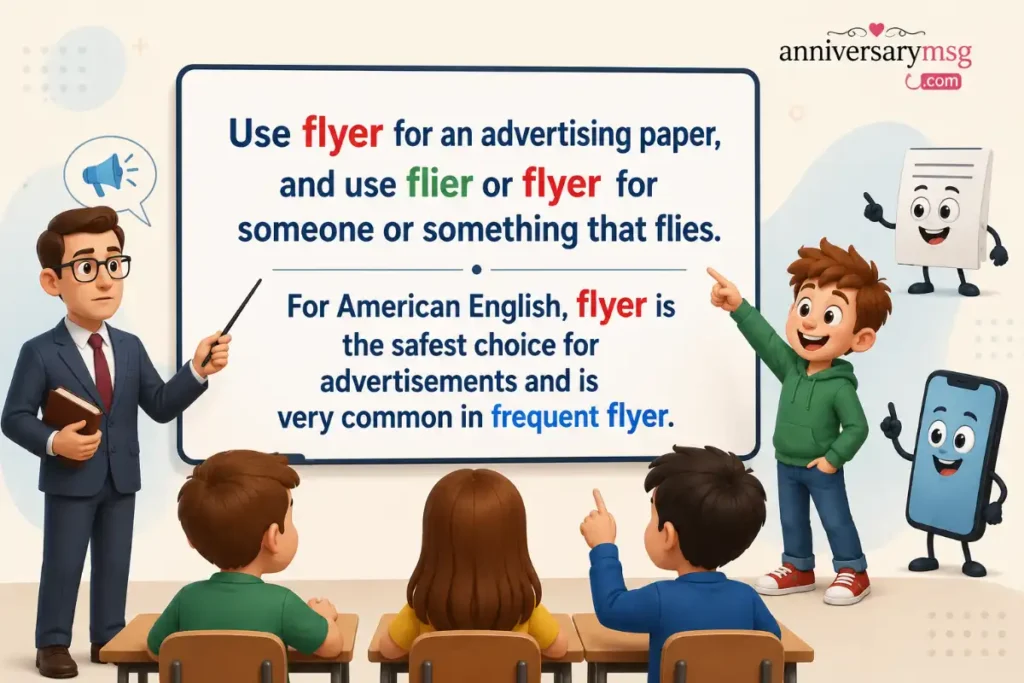
Both flier and flyer are correct English spellings.
Use flyer for an advertising paper, and use fliers vs flyers for someone or something that flies. For American English, flyer is the safest choice for advertisements and is very common in frequent flyer.
Conclusion
The difference between fliers vs flyers is mainly about common usage and meaning rather than a simple right or wrong rule. Flyer is the best everyday choice for a promotional paper, such as a store advertisement, event notice, or restaurant offer. Flier is also correct and can describe a person or thing that flies. However, flyer is very common in phrases such as frequent flyer, especially in American English.
The easiest rule to remember is to choose flyer when you mean an advertising paper. When you mean someone or something that flies, both flier and flyer can be used. If you’re writing for a US audience and you’re unsure about the spelling, flyer is often the safest choice. Once you focus on the meaning and the context, this spelling difference becomes much easier.
Frequently Asked Questions
Is flier or flyer correct?
Both are correct. Flyer is especially common for advertising papers, while flier is often used for someone or something that flies.
What is the difference between flier and flyer?
The two words overlap. Flyer is commonly used for an advertising paper, while flier can describe a person or thing that flies.
Is flyer American or British English?
Flyer is used in both American and British English. American English commonly uses it for advertising papers and in the phrase frequent flyer.
Should I use flyer for an advertisement?
Yes. Flyer is the safest and most familiar choice for an advertising paper in American English.
Is frequent flier correct?
Yes. Frequent flier is an accepted form. However, frequent flyer is a very common expression in American English.
Can flyer mean a person who flies?
Yes. Flyer can describe a person or thing that flies. For example, “She’s a frequent flyer.”
Can flier mean an advertising paper?
Yes. Flier can also mean a promotional paper or leaflet, although flyer is usually the more familiar choice for this meaning.
How do I remember flier vs flyer?
Remember flyer for an advertisement. For a person or thing that flies, both flier and flyer can work.

Ryan is a creative writer and relationship content specialist who believes in the power of meaningful words. He focuses on anniversaries, love notes, and memorable messages that make people feel connected. When not writing, Ryan loves kayaking, attending live jazz performances, and collecting vintage postcards from his travels.