If you have ever wondered about theater or theatre, you may have noticed that both spellings appear in English. You might see “theater” on an American movie website and “theatre” on a British website. So, which spelling is correct?
The short answer is that theater and theatre are both correct. The main difference is where the spelling is commonly used. Theater is the usual spelling in American English. Theatre is more common in British English and many other varieties of English.
This difference can be confusing because the two words have the same meaning and the same pronunciation in most situations. They both refer to a place where people watch plays, movies, or other performances. The difference is mainly a matter of spelling and regional style.
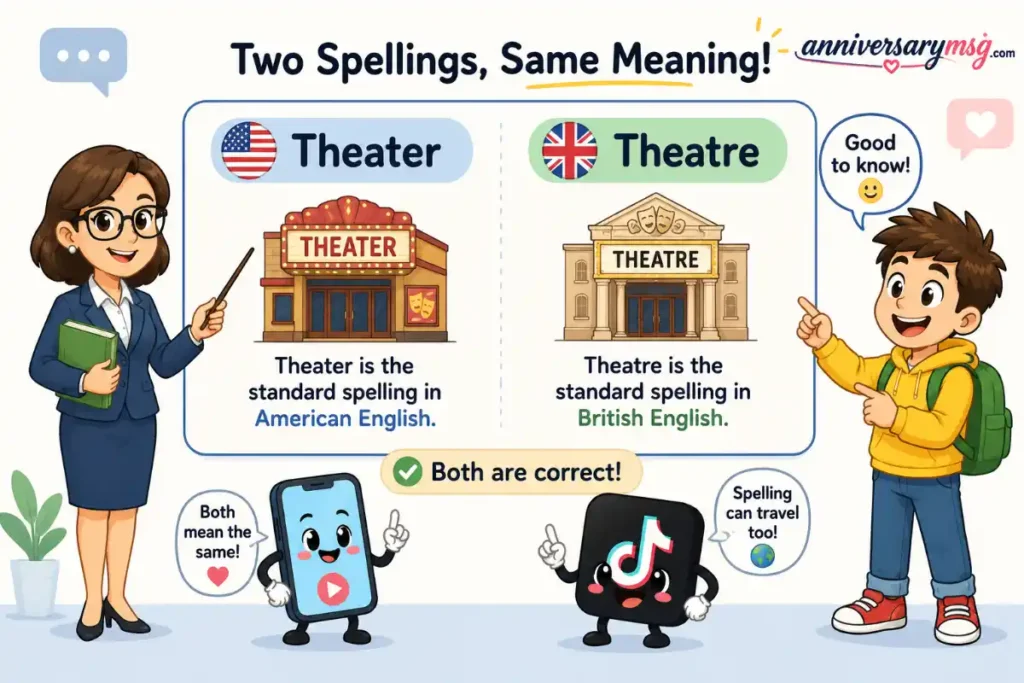
Simple Answer in One Look: Theater or Theatre
Theater is the standard spelling in American English.
Theatre is the standard spelling in British English.
Both words have the same basic meaning. If you are writing for a US audience, theater is usually the better choice.
For example:
“I went to the theater last night.”
A British writer might write:
“I went to the theatre last night.”
Both sentences are correct.
Explore our detailed article on Time Flies or Time Flys to understand the difference quickly.
What This Means in Simple English
Think of theater and theatre as two spellings of the same word.
The meaning does not change.
The place is still a theater or theatre.
The actors are still actors.
The audience is still the audience.
The performance is still a performance.
Only the spelling changes.
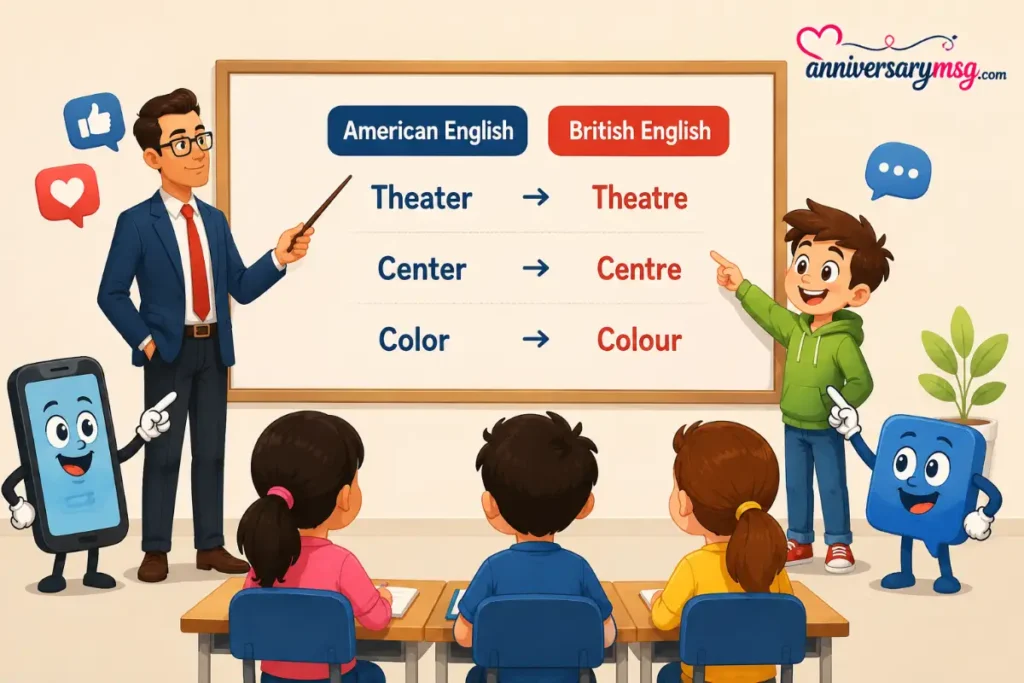
This is similar to other differences between American and British English. For example, American English often uses “color,” while British English uses “colour.” American English uses “center,” while British English uses “centre.”
The same idea applies here.
American English → theater
British English → theatre
The spelling with -er is strongly connected with American English. The spelling with -re is strongly connected with British English.
If you live in the United States or are writing for American readers, you will usually see theater.
For example:
“The movie theater is near my house.”
“She works at a local theater.”
“We went to the theater to see a play.”
If you are reading a British newspaper or visiting the United Kingdom, you are more likely to see theatre.
For example:
“The theatre is near the train station.”
“She studied theatre at university.”
“We went to the theatre to see a play.”
Neither spelling is a mistake.
The important thing is to understand the regional difference.
Why People Mix These Words
People often mix up theater or theatre because both spellings are used by English speakers.
English is spoken in many countries. Different countries have developed their own spelling habits over time.
A student in the United States may learn “theater” in school. A student in the United Kingdom may learn “theatre.”
Then both students may read books, watch movies, use social media, or visit websites written by people from other countries.
That is when the confusion starts.
A US student might see:
“Royal Theatre”
and wonder why the word has an extra “re” ending.
A British student might see:
“Movie Theater”
and wonder why the spelling uses “er.”
Neither writer necessarily made a spelling mistake.
They may simply be following the spelling style used in their country.
There is another reason people get confused. The pronunciation usually stays the same.
You do not normally hear a major pronunciation change when someone says “theater” or “theatre.”
That means you cannot easily tell the spelling from speech.
You have to learn the spelling based on the type of English you are using.
The word can also describe different kinds of places.
A theater can be a place where people watch movies.
A theater can also be a place where actors perform plays.
It can even refer to a place used for concerts, dance performances, or other shows.
For example:
“We went to the movie theater.”
“The theater was full of people.”
“She performed on a theater stage.”
The same meanings apply to theatre.
This is why the question is not really about meaning. It is mostly about spelling and regional English.
Clear Difference Explained Simply
Here is the easiest comparison.
- Theater is the usual American English spelling.
- Theatre is the usual British English spelling.
- Both words have the same basic meaning.
- Both can refer to a place where people watch performances.
- Both can refer to the world of plays and acting.
- The pronunciation is usually the same.
- The choice depends mainly on the English style you are using.
A simple visual rule is:
US English → theater
UK English → theatre
For a US audience, write:
“The movie theater was crowded.”
For a British audience, write:
“The movie theatre was crowded.”
Both sentences communicate the same idea.
You may also see both spellings in names.
A company, school, theater group, or building may choose a particular spelling as part of its official name.
For example, an organization in the United States might still use “Theatre” in its name because of tradition or branding.
So you should not automatically assume that every US organization must use “theater.”
Proper names can follow their own style.
Which Form Should You Use
If you are writing in American English, use theater in normal writing.
This is the easiest rule for US students, bloggers, businesses, and general writers.
For example:
“I bought tickets for the theater.”
“The theater opens at seven.”
“We watched a movie at the theater.”
If you are writing in British English, use theatre.
For example:
“I bought tickets for the theatre.”
“The theatre opens at seven.”
“We watched a play at the theatre.”
The most important thing is consistency.
If your article is written in American English, do not switch between “theater” and “theatre” without a reason.
Choose one style and stay with it.
For a US website, theater is usually the natural choice.
For a UK website, theatre is usually the natural choice.
This rule also helps with related words.
American English often uses:
“theatergoer”
“theater company”
“theater production”
British English often uses:
“theatregoer”
“theatre company”
“theatre production”
These forms follow the same regional spelling pattern.
There is one small point to remember. Some words and names do not always follow the general rule because organizations choose their own spelling.
So, if you are writing the official name of a place or organization, copy its official spelling.
Easy Real Life Sentences You Can Use
Here are some simple examples using the American spelling.
- “We went to the theater after dinner.”
- “The movie theater was packed.”
- “She wants to work in theater someday.”
- “The new theater opened last month.”
- “I bought two tickets for the theater.”
- “The actors walked onto the theater stage.”
- “Our school has a small theater.”
- “The movie starts at eight at the theater.”
Now look at the British spelling.
- “We went to the theatre after dinner.”
- “The theatre was packed.”
- “She wants to work in theatre someday.”
- “The new theatre opened last month.”
- “I bought two tickets for the theatre.”
The meaning stays the same.
Only the spelling style changes.
This is a useful lesson because English has many regional spelling differences. You do not always need to ask which spelling is absolutely correct. Sometimes both forms are correct in different varieties of English.
Where This Word Comes From Simple History
The history of theater or theatre goes back to ancient Greek.
The English word comes from a Greek word connected with a place for watching performances.
The idea of a theater is very old. Ancient Greek communities built spaces where people could watch plays and other performances.
The word later passed through other languages before becoming part of English.
The spelling theatre is closely connected with French influence and older European spelling traditions.
The spelling theater became common in American English as spelling practices developed in the United States.
Over time, American English adopted many spelling patterns that were different from British English.
This is also why American English has forms such as:
“center” instead of “centre”
“color” instead of “colour”
“favorite” instead of “favourite”
“theater” instead of “theatre”
These differences do not mean one version is better.
They show how English changes from place to place.
English is a living language. People use it in different countries, and those countries can develop different spelling habits.
A Small Bridge to Deeper Understanding
Now the basic spelling question should be clear. Theater and theatre mean the same thing, but the preferred spelling depends on the English variety.
There is more to the word than spelling, though. It also has a strong connection with movies, acting, stories, culture, and live performance. Understanding these uses can help you recognize the word when you see it in books, signs, websites, and everyday conversations.
How This Word Is Understood in Culture and Stories
A theater is more than just a building.
For many people, it is a place where stories come alive.
People sit in seats and watch actors perform. They may laugh, cry, cheer, or feel nervous for a character.
A movie theater works in a similar way.
People enter a dark room, sit together, and watch a story on a large screen.
Theater also has a special place in American culture.
Broadway in New York City is one famous example. Broadway is strongly connected with live musical theater and stage performances.
People travel to New York to watch famous shows.
Local theaters are also important.
Many towns have community theaters where local actors perform plays and musicals.
Schools often have theaters too.
Students may act in school plays, perform music, or take part in drama programs.
The word can therefore bring different images to mind.
For one person, theater means a movie house.
For another person, it means live acting.
and, For another, it means the art of creating plays and performances.
The meaning depends on the sentence.
For example:
“I went to the theater to watch a movie.”
Here, theater means a movie theater.
“She studied theater in college.”
Here, theater means the art and study of acting and stage performance.
“The theater was full of actors.”
Here, the word may refer to the theater world or a place connected with performances.
The British spelling theatre carries the same ideas.
Biblical and Mythological Meaning If Applicable
There is no special biblical meaning behind theater or theatre.
The word refers to places, performances, acting, and the art of telling stories.
It is not a religious term.
There is also no special mythological meaning that you need to learn to use the word correctly.
However, plays and performances have existed in many cultures for a very long time.
Ancient Greek culture is especially important in the history of Western theater.
Greek communities created plays that included comedy and tragedy.
These performances told stories about people, families, heroes, gods, choices, and difficult events.
Some ancient Greek stories are still performed today.
This helps explain why theater is closely connected with storytelling.
People have always enjoyed watching stories acted out in front of them.
The spelling difference between theater and theatre does not come from different religious or mythological meanings.
It is mainly a regional spelling difference in English.
Symbolism Explained in Simple Words
The word theater can carry different ideas depending on how people use it.
It can represent storytelling, imagination, performance, and shared experiences.
The word theatre can carry the same ideas.
The spelling itself does not create a different meaning.
What One Version Represents
Theater often represents American English style.
When you see “theater” on a US website, sign, or school page, it may immediately feel familiar to American readers.
The word can also represent entertainment and storytelling.
A movie theater can mean a night out with friends.
A stage theater can mean actors performing a play.
A school theater can mean students practicing for a show.
So the word can connect with many experiences.
What the Other Version Represents
Theatre often represents British English style.
It may also appear in writing from Australia, Ireland, and other places influenced by British English, although spelling preferences can vary.
The meaning remains the same.
A theatre can be a place for plays, a place for performances, or a term for the art of acting and stage production.
The important lesson is simple:
The spelling does not change the basic meaning.
Related Words You Should Know
Learning a few related words makes the difference between theater or theatre easier to understand.
Theater
In American English, this is the common spelling for a place where people watch movies or performances.
Theatre
This is the common British English spelling of the same word.
Movie theater
A place where people watch movies on a large screen.
In British English, you may also see “cinema” used for this meaning.
Stage
The raised area where actors perform.
For example, “The actor walked onto the stage.”
Actor
A person who performs a character in a play, movie, or show.
Actress
A traditional term for a female actor. Today, “actor” is also commonly used for people of any gender.
Audience
The people watching a performance.
Play
A story written to be performed by actors on a stage.
Performance
An act of presenting a play, song, dance, or other show to an audience.
Drama
A type of story or performance that often focuses on serious events, emotions, or conflicts.
Cinema
A word often used for movies and movie theaters, especially in British English.
Broadway
A famous theater district and theater industry in New York City.
Theatergoer
A person who often goes to the theater.
In British English, theatregoer is a common spelling.
These related words help you see how the term works in real English.
How People Actually Use It in Daily English
The best way to understand theater or theatre is to see the word in normal situations.
Imagine a family planning a weekend.
“Do you want to go to the theater?”
In American English, this may mean going to a movie theater or seeing a performance.
A friend may ask:
“What movie is playing at the theater?”
Here, the meaning is clearly a movie theater.
Now imagine students preparing for a school show.
“Our theater group is performing Friday.”
Here, theater refers to acting and performance.
A person might also say:
“I love live theater.”
This means they enjoy watching live stage performances.
Another person might say:
“The movie theater is five minutes from my house.”
Here, it means a place for movies.
In British English, the same ideas may be written with theatre.
For example:
“I love live theatre.”
“The theatre is near my house.”
“The theatre group is performing tonight.”
This shows why context matters.
The spelling may change, but the basic idea stays the same.
Theater or Theatre Compared With Other English Spelling Differences
The difference between theater or theatre is similar to other American and British English spelling differences. The meaning stays the same, but the spelling changes based on the English style.
| American English | British English |
|---|---|
| Theater | Theatre |
| Center | Centre |
| Color | Colour |
| Favorite | Favourite |
| Humor | Humour |
| Labor | Labour |
| Meter | Metre |
These differences are normal in English. American English often uses simpler endings such as -er, while British English keeps forms such as -re in some words.
For example, an American writer may say, “The theater is near the center of town.” A British writer may write, “The theatre is near the centre of town.” Both sentences are correct for their regional style.
The key is consistency. If you choose American English, use theater, center, and color. If you choose British English, use theatre, centre, and colour.
How to Choose the Right Spelling for Your Audience
Choosing between theater and theatre becomes easy when you think about your readers first.
If you are writing for people in the United States, choose theater. This is the spelling most US readers expect to see in general writing.
If you are writing for people in the United Kingdom, choose theatre. This spelling is more familiar to British readers.
For an international website, you can use either spelling, but staying consistent makes your writing easier to follow. You can also mention both forms when your article is specifically explaining the difference.
For example, a US-focused article could say, “Theater is the standard American spelling, while theatre is the British spelling.”
One more tip is worth remembering. Always keep the official spelling of a company, school, building, or organization name. If an organization calls itself a “Theatre Company,” do not change its name to “Theater Company.”
The simple rule is: match the spelling to your audience and keep your writing consistent.
Common Mistakes People Make
One common mistake is believing that theatre is wrong in American English.
It is not wrong.
It is simply less common as the general spelling in American English.
Another mistake is believing that theater is wrong in British English.
It is not always wrong either. You may see the American spelling in names, international writing, or specific contexts.
The main difference is the usual regional preference.
Another mistake is switching spelling styles inside the same article.
For example, a US article might use “theater” in one paragraph and “theatre” in another without a reason.
That can make the writing look inconsistent.
If you are writing for American readers, choose theater and use it consistently.
If you are writing for British readers, choose theatre and use it consistently.
A fourth mistake is thinking that the spelling changes pronunciation.
In normal English speech, both forms are generally pronounced the same.
You cannot hear the difference as clearly as you can see it.
A fifth mistake is thinking that “theater” only means a place for movies.
The word can also refer to live stage performances and the art of acting.
For example:
“She studied theater.”
This does not mean she studied movie buildings.
It means she studied acting, stage performance, or the theater arts.
Another mistake is confusing “theater” with “cinema.”
In American English, movie theater is very common.
In British English, cinema is often used for a place where people watch movies.
For example:
US English: “We went to the movie theater.”
British English: “We went to the cinema.”
The words can describe similar places, but regional habits are different.
Theater or Theatre in American English
For American English, theater is the spelling you should normally choose.
This applies to school assignments, blogs, general websites, emails, and everyday writing.
Examples include:
“Movie theater”
“Community theater”
“Dinner theater”
“Theater production”
“Theater company”
Also “Theater program”
“Theater arts”
“Local theater”
These forms are familiar to US readers.
However, remember that official names can use a different spelling.
A theater company might call itself a “Theatre Company.”
A building might have “Theatre” in its official name.
If you are writing the proper name, keep the organization’s chosen spelling.
That is not a spelling mistake.
It is simply the official name.
Theater or Theatre in British English
For British English, theatre is the usual spelling.
Examples include:
“Movie theatre”
“Community theatre”
“Theatre production”
“Theatre company”
Also “Theatre program”
“Theatre arts”
“Theatre school”
And “Theatre audience”
British writers often use the -re ending in several words.
This is why the spelling may look familiar in words such as “centre” and “metre.”
American English often uses:
“center”
“meter”
“theater”
British English often uses:
“centre”
“metre”
“theatre”
Learning these patterns can make regional spelling easier to recognize.
Is Theater or Theatre More Correct
Neither spelling is more correct in every situation.
The correct choice depends on the English style you are using.
If your audience is mainly in the United States, theater is the best general choice.
If your audience is mainly in the United Kingdom, theatre is the usual choice.
This is an important point for students.
Sometimes English has two correct forms.
You do not need to choose one form and call the other wrong.
Instead, ask:
“What kind of English am I writing?”
If the answer is American English, use theater.
If the answer is British English, use theatre.
This simple question can solve the problem.
How to Remember the Difference
Here is an easy memory trick.
Think of the last two letters.
Theater → US English
Theatre → UK English
You can connect “er” with the American spelling.
You can connect “re” with the British spelling.
Another way to remember it is by thinking about other spelling pairs.
American:
“center”
“color”
“favorite”
“theater”
British:
“centre”
“colour”
“favourite”
“theatre”
You do not need to memorize every spelling difference at once.
Just learn the pattern slowly.
Final Teacher Explanation Very Important
If I were teaching this in a classroom, I would write two words on the board:
THEATER
THEATRE
Then I would ask, “Are these two different words?”
The answer is no.
They are two spellings of the same word.
Next, I would write:
American English → theater
British English → theatre
That is the main lesson.
Both spellings are correct.
The choice depends on the English style.
If you are writing for people in the United States, use theater.
If you are writing for people in the United Kingdom, use theatre.
Then I would give the class one more example.
American English:
“I went to the movie theater.”
British English:
“I went to the cinema.”
This shows another interesting difference.
English does not always use the same words or spellings in every country.
That does not make one form bad.
It simply means English has different regional varieties.
You may also see theatre in American names.
Do not change an official name just to follow your usual spelling.
If a theater company officially uses “Theatre,” keep it that way.
The same rule works for business names, school names, event names, and building names.
The biggest mistake would be thinking that theater or theatre is a choice between right and wrong.
It is usually a choice between American and British spelling.
Once you understand that, the question becomes much easier.
Final Answer Quick Recap
Theater is the usual American English spelling.
Theatre is the usual British English spelling.
Both have the same meaning and pronunciation in normal use. For a US audience, choose theater. For a UK audience, choose theatre.
Frequently Asked Questions FAQs
Is theater or theatre correct?
Both are correct. Theater is the usual American English spelling, while theatre is the usual British English spelling.
What is the difference between theater and theatre?
There is no major difference in meaning. The main difference is the spelling style used in different English-speaking regions.
Which is correct in American English?
Theater is the standard spelling in American English.
Which is correct in British English?
Theatre is the standard spelling in British English.
Is theatre wrong in American English?
No. You may see theatre in official names, titles, or organizations in the United States. However, theater is the usual general spelling.
Is theater wrong in British English?
No. The spelling theatre is more common in British English, but theater can appear in specific names and other contexts.
Do theater and theatre sound different?
Usually, no. They are generally pronounced the same in normal English speech.
Should I use theater or theatre for a US website?
Use theater for a US-focused website unless you are writing an official name that uses theatre.
Conclusion
The question of theater or theatre has a simple answer. Both spellings are correct, but they belong to different regional spelling styles. Theater is the common American English form, while theatre is the common British English form. Both words have the same basic meaning, and the difference does not change what the word means.
If you are writing for a US audience, choose theater and use it consistently. If you are writing for a British audience, choose theatre. Once you remember this simple rule, you will not need to worry about which spelling is correct. Just match the spelling to the type of English you are using.

Ryan is a creative writer and relationship content specialist who believes in the power of meaningful words. He focuses on anniversaries, love notes, and memorable messages that make people feel connected. When not writing, Ryan loves kayaking, attending live jazz performances, and collecting vintage postcards from his travels.