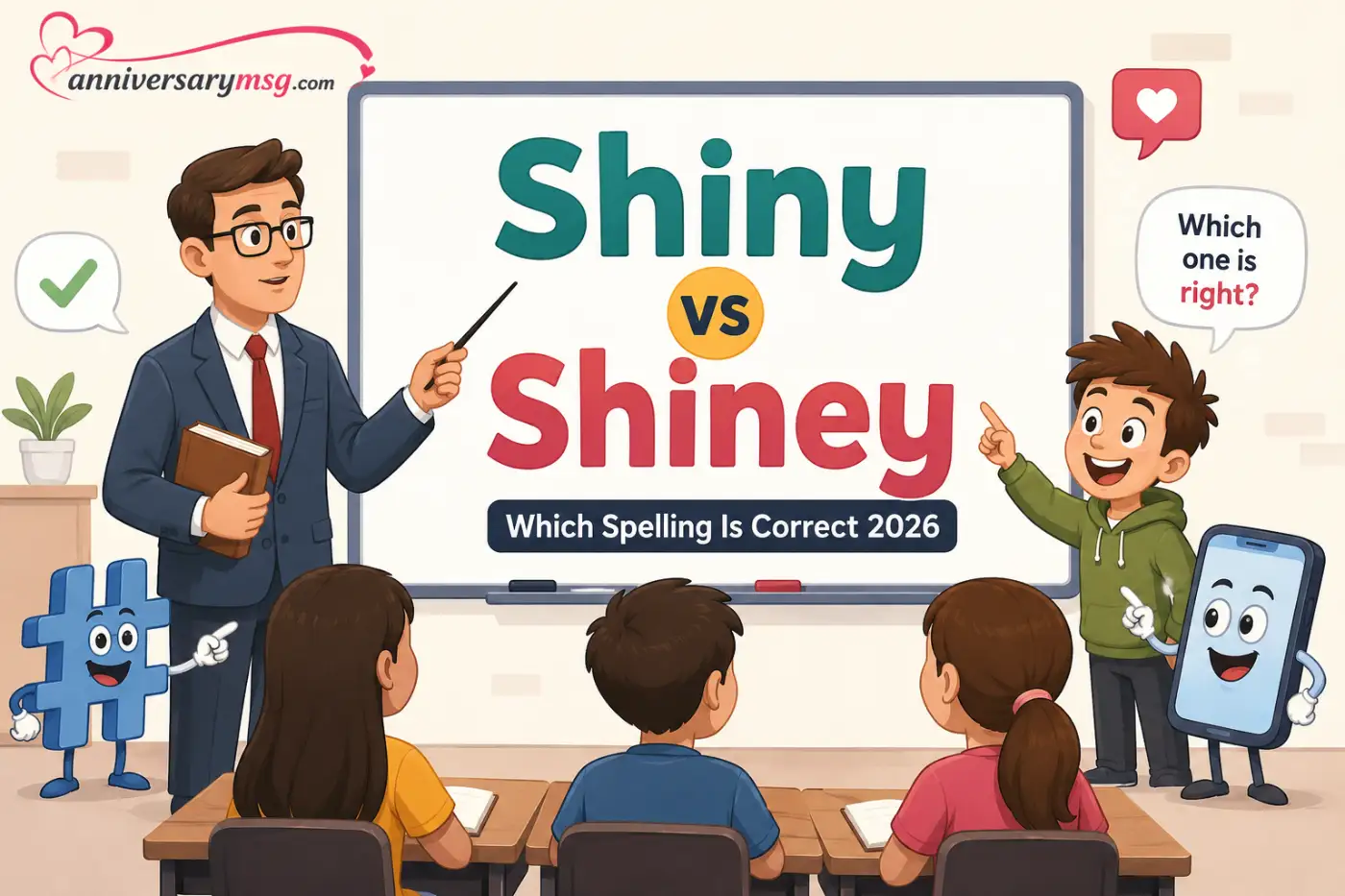
If you’re confused about shiny vs shiney, you’re not alone. These two spellings look almost the same, but only one is the standard English spelling. The correct spelling is shiny. The spelling shiney is generally considered a misspelling.
The word shiny means something has a bright, smooth, or reflective surface. For example, you can have a shiny car, shiny shoes, shiny hair, or a shiny new phone. The word comes from shine, but when we add y, we spell it shiny, not shiney.
So, which is correct? Use shiny in your school work, emails, articles, and other standard English writing. You may see shiney online because people sometimes spell words based on how they sound. However, shiny is the spelling you should remember.
Simple Answer in One Look About Shiny vs Shiney
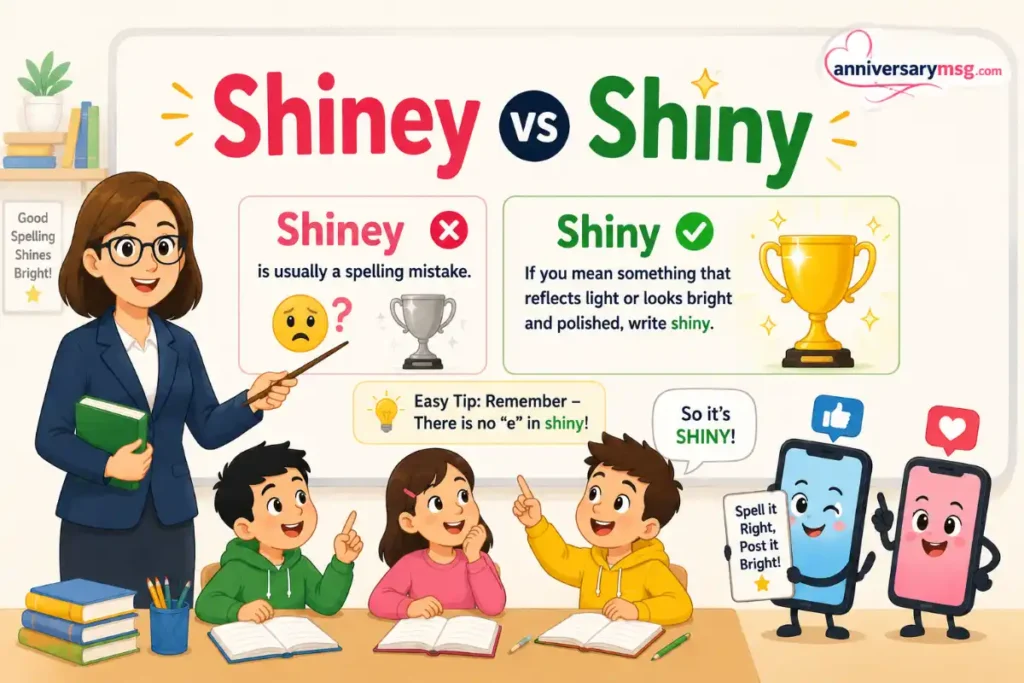
Shiny is the correct standard spelling.
Shiney is usually a spelling mistake. If you mean something that reflects light or looks bright and polished, write shiny.
Here is the simple example:
Correct: “She bought a shiny new car.”
Incorrect: “She bought a shiney new car.”
The correct form is shiny.
Master fliers vs flyers with easy rules, examples, and common mistakes to avoid.
What This Means in Simple English
The word shiny describes something that reflects light or has a bright surface.
Think about a clean mirror. Light hits the surface and reflects. The mirror looks shiny.
Now think about a new pair of shoes. If the shoes have a smooth surface that catches the light, you can call them shiny.
You can use shiny for many things.
A shiny coin can catch the light.
A shiny floor can look bright after it has been cleaned.
The shiny car can look bright after a wash.
A shiny jacket can have a bright or reflective material.
A shiny object may look polished, smooth, bright, or reflective.
The exact meaning can change a little based on the object.
For example, shiny hair usually means hair that looks smooth and has a healthy-looking glow.
Shiny shoes often means shoes with a polished surface.
Shiny metal means metal that reflects light.
And shiny paper means paper with a smooth surface that reflects light more than normal paper.
The main idea stays the same.
Something is shiny when it catches or reflects light and looks bright.
Now we can understand why the spelling can cause trouble.
The base word is shine.
When we want to describe something that has the quality of shining, we use shiny.
We do not normally keep the extra e.
That gives us:
Shine + y = shiny.
Not:
Shine + y = shiney.
This is one of those small spelling rules that can seem confusing at first.
The good news is that you only need to remember one form.
Shiny is the standard spelling.
Why People Mix These Words
The main reason people confuse shiny vs shiney is simple: the word shine already ends with the letter e.
When people see shine, they may naturally think that adding y gives us shiney.
That seems logical.
For example:
shine + y = shiney.
But English spelling does not always work by simply adding a letter to the end of the base word.
When shiny is formed, the final e in shine is dropped.
So:
shine → shiny.
This is similar to other English words where a final silent e disappears before a suffix is added.
Look at these examples:
noise → noisy.
ice → icy.
spice → spicy.
But notice something interesting.
People often remember the original word and try to keep every letter.
They see shine and think:
“I need to keep the e.”
That creates shiney.
However, the standard spelling does not keep the final e.
The correct form is shiny.
Pronunciation also causes confusion.
Shiny is commonly pronounced like “SHY-nee.”
The spelling does not sound exactly like the full word shine plus a separate “y” sound.
That can make the spelling less obvious for English learners.
Another reason is that shiney looks believable.
It has the same letters as shine plus y.
When someone reads it quickly, they may not notice the mistake.
You may even find shiney in social media posts, comments, usernames, informal messages, or other online writing.
Seeing a misspelling many times can make it look correct.
But frequency does not always mean correctness.
If you search for the standard spelling, use shiny.
Clear Difference Explained Simply
The difference between shiny vs shiney is mainly a spelling difference.
| Spelling | Correct? | Meaning |
|---|---|---|
| shiny | Yes | Bright, smooth, or reflective |
| shiney | No in standard English | Usually a misspelling of shiny |
There is no major difference in meaning because shiney is generally not treated as a separate standard English word.
The important thing to remember is this:
Shiny is the word.
Shiney is normally the spelling error.
Here are some examples.
Correct:
“The floor looks shiny.”
Incorrect:
“The floor looks shiney.”
Correct:
“He has shiny black shoes.”
Incorrect:
“He has shiney black shoes.”
Correct:
“The new car has a shiny surface.”
Incorrect:
“The new car has a shiney surface.”
Correct:
“She wore a shiny dress.”
Incorrect:
“She wore a shiney dress.”
The meaning stays the same in these examples, but the spelling changes.
If you are writing something important, always choose shiny.
Which Form Should You Use?
Use shiny.
That is the easiest answer.
If you are writing a sentence about something that reflects light or looks bright, write shiny.
For example:
“The table is shiny.”
“Her shoes are shiny.”
“I bought a shiny new watch.”
“The silver spoon looks shiny.”
“The floor became shiny after cleaning.”
Avoid using shiney in standard English writing.
You should especially use shiny in school assignments, tests, resumes, business writing, blog posts, websites, and formal documents.
If you see shiney somewhere online, do not assume that it is another accepted spelling.
It is usually just a spelling mistake.
There is one useful thing to understand here.
English contains many words that are formed from a base word plus y.
Sometimes the base word changes slightly.
For example:
sun → sunny.
rain → rainy.
cloud → cloudy.
noise → noisy.
ice → icy.
spice → spicy.
shine → shiny.
The spelling pattern is not always the same, but the result is easy to learn when you see enough examples.
The best habit is to remember shiny as one complete word.
Do not try to build it every time from shine.
Think:
Shiny = bright or reflective.
That will help you avoid the spelling mistake.
Easy Real-Life Sentences You Can Use
Here are some simple sentences with shiny.
“The new car looks shiny.”
“My shoes are clean and shiny.”
“She has shiny brown hair.”
“The kitchen floor looks shiny.”
“He found a shiny coin.”
“The dog has a shiny coat.”
“I bought a shiny black backpack.”
“The silver ring is very shiny.”
These examples show how flexible the word can be.
You can use shiny before a noun.
“She has shiny hair.”
You can also use it after a linking verb.
“Her hair looks shiny.”
The word usually describes how something looks.
It can describe an object’s surface, color, material, or appearance.
For example, a black car can be shiny.
A red apple can be shiny.
A silver spoon can be shiny.
A gold ring can be shiny.
A person’s hair can be shiny.
A clean floor can be shiny.
The object does not have to be naturally bright.
Something can become shiny after cleaning, polishing, or adding a special coating.
For example:
“The cleaner made the floor shiny.”
“The polish made my shoes shiny.”
“The car wash left the car shiny.”
This shows another common meaning of the word.
Where This Word Comes From Simple History
The word shiny comes from the English word shine.
The word shine is very old. It has roots in Old English and is related to older Germanic words connected with brightness and light.
Over time, English speakers used related forms of shine to describe things that give off or reflect light.
The ending y is also common in English.
It can help turn a noun or another word into an adjective that describes a quality.
For example:
sun → sunny.
rain → rainy.
cloud → cloudy.
noise → noisy.
shine → shiny.
So shiny basically describes something that has the quality of shining.
The spelling is not shiney because the final e from shine is dropped when the word takes this form.
This is not a special rule that applies only to shiny.
English has many spelling patterns where a final silent e disappears before another ending is added.
That is why learning the complete word is often easier than trying to work out the spelling every time.
If you remember that shiny is the standard form, you will avoid the most common mistake.
A Quick Way to Remember Shiny
Here is a simple classroom trick.
Think about the word icy.
You do not write:
icey.
You write:
icy.
Now think about shiny.
You do not write:
shiney.
You write:
shiny.
The final e disappears.
You can also remember this short line:
Shine becomes shiny, not shiney.
Say it a few times and the spelling will become easier to remember.
Another helpful trick is to connect the word with a picture.
Imagine a bright silver coin.
Look at it and think:
“Shiny coin.”
Now imagine a polished car.
Think:
“Shiny car.”
The more often you see the correct spelling, the more natural it will become.
Why Shiney Looks Correct at First
English spelling can be tricky because words do not always look exactly how we expect.
Shiney looks reasonable because the word shine already exists.
A learner may think:
“I only need to add y.”
That is a very normal mistake.
The problem is that English spelling often changes when a word receives an ending.
Think about happy.
You would not spell it happey just because the word happen exists.
Now think about noisy.
The base word is noise, but the final e disappears.
So we write:
noise → noisy.
We do the same basic thing with:
shine → shiny.
Once you see the pattern, shiny starts to look much more natural.
Shiny as an Adjective
There is another simple point worth knowing.
Shiny is an adjective.
That means it describes a person, place, thing, or surface.
For example:
“a shiny car.”
The word shiny describes the car.
“shiny shoes.”
The word describes the shoes.
“a shiny floor.”
The word describes the floor.
You can also use it after words such as is, looks, or seems.
“The floor is shiny.”
“The floor looks shiny.”
“Her hair looks shiny.”
These are all natural sentences.
You do not need a complex grammar rule to use the word correctly.
Just remember that shiny tells us what something looks like.
Shiny Does Not Always Mean New
Some people connect shiny with something new.
That makes sense because new objects are often clean and polished.
But shiny does not always mean new.
An old object can be shiny too.
For example:
“My grandfather has an old but shiny watch.”
The watch is old, but its surface still reflects light.
An old coin can be shiny after polishing.
An old car can look shiny after a good wash.
A piece of furniture can be old but have a shiny finish.
So remember:
Shiny describes appearance, not age.
Something can be old and shiny.
Something can also be new and dull.
That small difference can help you understand the word more clearly.
A Simple Difference Between Shine and Shiny
The words shine and shiny are related, but they are not used in the same way.
Shine can describe the action of giving or reflecting light.
For example:
“The sun shines.”
You can also use shine as a verb.
“Please shine the light here.”
Shiny describes something that has a bright or reflective appearance.
For example:
“The table is shiny.”
So:
Shine = give off or reflect light.
Shiny = having a bright or reflective surface.
This is another reason the spelling shiney can be confusing.
The correct adjective changes shine into shiny.
It does not become shiney.
Deep Meaning Culture and Practical Use
The spelling question is simple: shiny is correct and shiney is normally a mistake. But knowing the spelling is only the first step. To use the word naturally, it helps to understand how people use shiny when talking about objects, beauty, cleaning, fashion, products, and everyday life.
How This Word Is Understood in Culture and Stories
The idea of something being shiny appears often in everyday American culture.
People usually connect shiny objects with cleanliness, beauty, freshness, attention, or something that stands out.
Think about a new car at a dealership.
The car may be carefully washed and polished so that its surface reflects the light.
Someone might say:
“That car is so shiny.”
The word does not simply tell us that the car reflects light. It can also suggest that the car looks attractive and well cared for.
The same idea appears with shoes.
People often polish dress shoes before an important event.
After polishing, the shoes may look shiny.
Someone might say:
“Your shoes look really shiny.”
In stories, a shiny object can also attract attention.
A character might find a shiny coin on the ground.
A child might notice a shiny toy in a store.
A person might see a shiny ring and become curious about it.
This is why shiny things are used in stories as objects that catch someone’s eye.
But there is no single hidden meaning behind the word.
The meaning depends on the situation.
A shiny object can look beautiful.
It can look new.
It can look expensive.
Also, it can look clean.
It can simply reflect a lot of light.
The surrounding sentence tells us what the speaker means.
Biblical and Mythological Meaning If Applicable
Shiny does not have one special biblical or mythological meaning.
It is an ordinary English adjective.
However, light and brightness often appear in religious stories, myths, and traditional literature.
People may describe gold, stars, jewels, armor, or other objects as bright or shining.
These objects can sometimes represent ideas such as beauty, glory, purity, wealth, or power.
But that symbolism belongs to the story or object.
It does not mean that the word shiny itself has a special religious meaning.
For example, if a story describes a shiny golden object, the gold may have symbolic meaning because of the story.
The adjective shiny simply tells the reader how the object looks.
This distinction is useful.
Words can describe something without having a deeper symbolic meaning themselves.
Symbolism Explained in Simple Words
The word shiny does not have one fixed symbol.
Still, people often connect shiny things with certain ideas.
What One Version Represents
The correct form shiny can describe something that catches attention.
A shiny object stands out because light reflects from it.
For example, imagine a room full of old wooden furniture.
Then you see one bright silver lamp.
Your eyes may go straight to the lamp.
You might say:
“The silver lamp is shiny.”
Because it reflects light, it gets noticed.
In stories and normal conversation, shiny things can therefore suggest something noticeable or attractive.
But this is a possible association, not a fixed definition.
What the Other Version Represents
Shiney does not have a separate symbolic meaning.
It is generally just a misspelling of shiny.
This is an important point.
Sometimes people see two spellings and assume they must have different meanings.
That is not the case here.
If you see shiney, the writer most likely intended to write shiny.
For example:
“Look at that shiney car.”
The intended standard sentence is:
“Look at that shiny car.”
The meaning has not changed.
Only the spelling needs correction.
Related Words You Should Know
Learning related words can make shiny easier to understand.
Shine
Shine means to give off or reflect light.
“The sun shines brightly.”
Shining
Shining describes something that is giving off or reflecting light.
“The sun is shining.”
It can also describe something that looks bright.
“She has shining eyes.”
Bright
Bright means giving off or reflecting a lot of light.
“The room is bright.”
It can also describe strong colors or intelligence.
Glossy
Glossy means smooth and able to reflect light.
“Her magazine has a glossy cover.”
This word is common when talking about paper, photos, and surfaces.
Polished
Polished means made smooth or shiny, often by rubbing or cleaning.
“He wore polished shoes.”
Sparkling
Sparkling can describe something that shines with many small points of light.
“The water was sparkling in the sun.”
Gleaming
Gleaming means shining brightly or looking very clean and polished.
“His new car was gleaming.”
Reflective
Reflective describes a surface that reflects light.
“The road sign has a reflective surface.”
This word is more common in technical or safety contexts.
Dull
Dull is almost the opposite of shiny when talking about surfaces.
A dull surface does not reflect much light.
“The old metal looked dull.”
These related words give you more choices when describing how something looks.
How People Actually Use Shiny vs Shiney in Daily English
People use shiny in many normal situations.
Talking About Cars
“That car looks shiny.”
This is common after someone washes or polishes a car.
Talking About Shoes
“Your shoes are really shiny.”
You might say this after someone polishes dress shoes.
Talking About Hair
“Her hair looks shiny.”
This usually means the hair looks smooth and reflects light.
Talking About Floors
“The floor is so shiny.”
A clean or polished floor may reflect light.
Talking About Jewelry
“She wore a shiny silver necklace.”
The word describes the surface of the necklace.
Talking About New Objects
“I bought a shiny new laptop.”
Here, shiny describes the appearance of the laptop.
The word new tells us about its age or condition.
Talking About Coins
“I found a shiny coin.”
The coin may look bright because its surface reflects light.
Talking About Paper
“The book has a shiny cover.”
This can describe a smooth, glossy cover.
Talking About Clothing
“She wore a shiny jacket.”
The material may reflect light.
Talking About Decorations
“We used shiny decorations for the party.”
The decorations may have bright or reflective surfaces.
These examples show that shiny is useful in many everyday situations.
Common Mistakes People Make Between shiny vs shiney
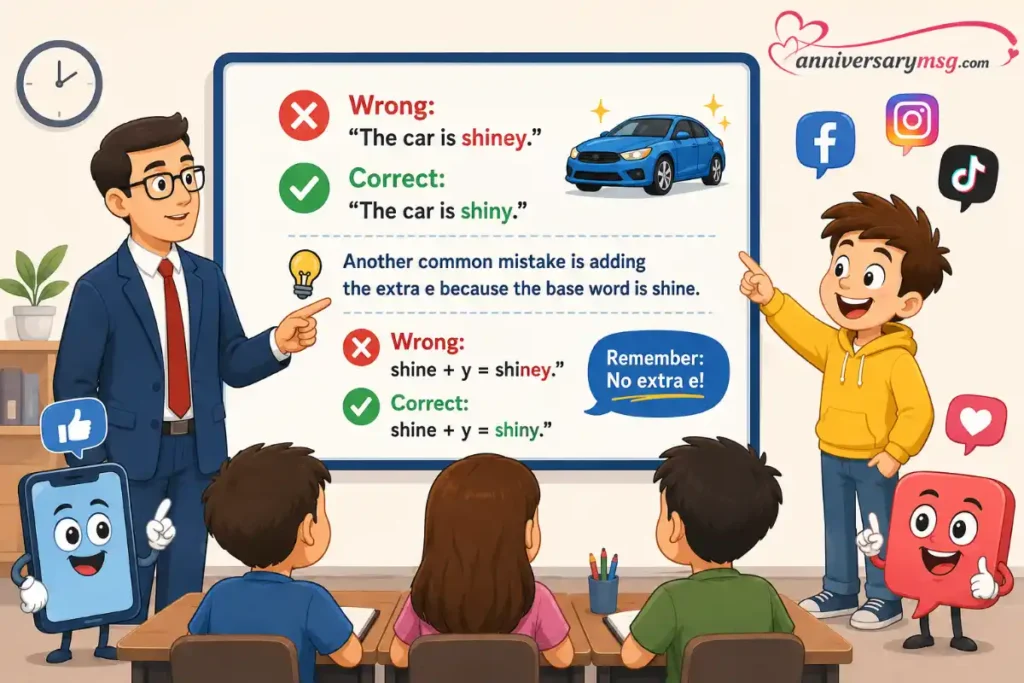
The biggest mistake is writing shiney instead of shiny.
Wrong:
“The car is shiney.”
Correct:
“The car is shiny.”
Another common mistake is adding the extra e because the base word is shine.
Wrong:
“shine + y = shiney.”
Correct:
“shine + y = shiny.”
Remember that the final e is removed.
Another mistake is using shiny when you really mean shining.
These words are related but can have different uses.
“The sun is shining.”
This describes the action happening now.
“The sun is shiny.”
This is not the normal way to describe the sun in everyday English.
We usually say that the sun is shining.
Now look at an object:
“The table is shiny.”
That is natural because the table has a reflective surface.
Another mistake is thinking that shiny always means expensive.
A cheap plastic toy can be shiny.
An expensive watch can be shiny.
The word describes appearance.
It does not tell us the price.
Another mistake is thinking that shiny always means clean.
A surface can be shiny because of its material.
For example, a polished metal object can be shiny.
A dirty object may even have a shiny surface.
So shiny mainly describes how the surface looks.
Shiny vs Glossy
Another common confusion is between shiny and glossy.
These words are close in meaning.
Shiny is a broad everyday word.
You can use it for shoes, cars, hair, metal, coins, floors, and many other things.
Glossy often describes a smooth surface with a strong shine.
It is especially common for paper, magazines, photographs, makeup, paint, and printed materials.
For example:
“Her shoes are shiny.”
“The magazine has glossy pages.”
Both words involve light and reflection, but shiny is the more general word.
Shiny vs Bright
Shiny and bright can also be confused.
A shiny object reflects light.
A bright object may produce a lot of light or have a strong color.
For example:
“The mirror is shiny.”
“The lamp is bright.”
A mirror does not produce its own light. It reflects light.
A lamp produces light.
This is a simple way to see the difference.
Still, the two words can overlap.
You might say:
“She wore a bright, shiny dress.”
Here, bright describes the strong color or appearance, while shiny describes the reflective surface.
The Use of Shiny vs Shining
Shiny vs Shiney: these two words are related, but they often appear in different situations.
Shining can describe something that is giving off or reflecting light.
“The sun is shining.”
Shiny usually describes the surface or appearance of something.
“The car is shiny.”
Here is a simple memory trick:
Shining often describes an action.
Shiny often describes a quality or appearance.
That is not a rule for every possible sentence, but it is a helpful starting point for learners.
How to Use Shiny in Writing
Using shiny in writing is easy.
Place it before the noun when you want to describe the object.
Examples:
“A shiny car.”
“A shiny coin.”
Or “A shiny table.”
“A shiny ring.”
“A shiny floor.”
You can also place it after a linking verb.
“The car is shiny.”
“The coin looks shiny.”
“The floor became shiny.”
The word works well in simple descriptions.
For example:
“I saw a shiny object near the door.”
“The new shoes were shiny and clean.”
“She bought a shiny blue bag.”
“The polished table had a shiny surface.”
These sentences sound natural and clear.
How to Correct Shiney in a Sentence
If you see shiney in your writing, replace it with shiny.
For example:
Incorrect:
“My new shoes are shiney.”
Correct:
“My new shoes are shiny.”
Incorrect:
“The floor became shiney after cleaning.”
Correct:
“The floor became shiny after cleaning.”
Incorrect:
“She bought a shiney dress.”
Correct:
“She bought a shiny dress.”
Incorrect:
“I found a shiney coin.”
Correct:
“I found a shiny coin.”
The correction is simple.
Remove the extra e.
Shiney → Shiny.
A Quick Spelling Test of Shiny vs Shiney
Try this simple test between Shiny vs Shiney.
Complete the sentence:
“The car looks ______ after the wash.”
Which spelling looks right?
Shiney.
Or:
Shiny.
The answer is:
Shiny.
Now try another:
“She has ______ hair.”
The correct answer is:
Shiny.
One more:
“I found a ______ coin.”
Again:
Shiny.
If you can remember these examples, you already understand the spelling.
Why Shiny Is the Best Choice for SEO and Online Writing
If you are writing an article, product description, website page, or social media post, spelling matters.
Readers expect standard English.
Search engines also need clear signals about what your page is about.
If your topic is the word shiny, use the correct spelling naturally.
For example:
“Shiny means bright or reflective.”
“Shiny is the correct spelling.”
“Shiney is a common misspelling.”
These sentences are clear for readers and useful for people searching for the difference between the two forms.
You do not need to repeat the keyword in every sentence.
Natural writing is better.
Explain the question.
Give examples.
Answer common mistakes.
Then move on.
That is how a useful grammar article should feel.
Final Teacher Explanation of Shiny vs Shiney
If I were teaching this in a classroom, I would write two words on the board:
SHINY
SHINEY
Then I would put a big check next to shiny and a correction mark next to shiney.
I would explain it in one sentence:
Shiny is the correct spelling. Shiney is usually a misspelling.
Then I would write the base word:
shine
Next, I would show the correct form:
shine → shiny
The final e disappears.
You do not need to write:
shine → shiney
That is the mistake.
Now I would give the class a few examples.
“The car is shiny.”
“My shoes are shiny.”
“The coin is shiny.”
“Her hair looks shiny.”
“The floor is shiny.”
In every example, shiny describes how something looks.
It can mean bright, smooth, polished, or reflective.
It does not mean that the object must be new.
Also, It does not mean that the object must be expensive.
It does not mean that the object must be clean.
It simply tells us that the surface or appearance has a noticeable shine.
There is also no need to give shiney a different meaning.
It is generally not a separate standard word.
If you see it, think:
“Someone probably meant shiny.”
That is the main lesson.
Final Answer Quick Recap About Shiny vs Shiney
The correct spelling is shiny, not shiney. Shiny describes something bright, polished, smooth, or reflective.
Remember this simple rule: shine becomes shiny. Drop the final e before adding y. Use shiny in standard English writing.
Conclusion
The difference between shiny vs shiney is simple once you remember the correct spelling. Shiny is the standard English word for something that looks bright, smooth, polished, or reflective. Shiney is generally a spelling mistake, even though you may see it in casual online writing. The correct form comes from shine, with the final e removed before adding y.
If you are writing a school assignment, website article, email, product description, or any other standard English text, choose shiny. Think of the simple pattern shine → shiny, just as noise → noisy and ice → icy. Once you remember that small spelling change, you will never need to wonder about shiny vs shiney again.
Frequently Asked Questions FAQs
Is shiny or shiney correct?
Shiny is the correct standard spelling. Shiney is generally a misspelling.
What does shiny mean in simple English?
Shiny means bright, smooth, polished, or able to reflect light.
Why is shiney wrong?
The standard spelling drops the final e from shine before forming shiny.
How do you spell shiny correctly?
Spell it shiny: S-H-I-N-Y.
Can shiney ever be correct?
In standard English, shiney is generally not correct. Use shiny instead.
What is the difference between shiny and shining?
Shiny usually describes how something looks. Shining often describes something giving off or reflecting light.
Is shiny an adjective?
Yes. Shiny is an adjective because it describes something, such as shiny shoes or a shiny car.
What are synonyms for shiny?
Common related words include glossy, bright, polished, gleaming, and sparkling. The best choice depends on the sentence.

Ryan is a creative writer and relationship content specialist who believes in the power of meaningful words. He focuses on anniversaries, love notes, and memorable messages that make people feel connected. When not writing, Ryan loves kayaking, attending live jazz performances, and collecting vintage postcards from his travels.